• Skip to primary navigation
  • Skip to main content
  • Skip to primary sidebar

Dividend Magic

Saving and Investing towards Financial Independence in Malaysia

  • Facebook
  • Instagram
  • Twitter
  • HomeMain Page
  • Start HereHow to Invest
    • Start Here – Read this First
    • Stock Investing Guide
    • REITs
    • Stock Brokers Comparison
    • US and International Stock Broker Comparison
    • Best Dividend Stocks
    • Dividend and Growth Investing
    • Start Investing
  • My PortfoliosMy Investment Portfolios
    • Freedom Fund
    • US Portfolio
    • Crypto Portfolio
      • Luno Portfolio
      • Binance Portfolio
    • StashAway
    • P2P Lending -CapBay
    • Real Estate Portfolio
    • Dividend Magic’s Yearly Review
    • Dividend Income Updates
      • Dividend Income (Malaysia) Update 2026
      • Dividend Income (Malaysia) Update 2025
      • Dividend Income (Malaysia) Update 2024
      • Dividend Income Update 2023
      • Dividend Income Update 2022
      • Dividend Income Update 2021
      • Dividend Income Update 2020
      • Dividend Income Update 2019
      • Dividend Income Update 2018
      • Dividend Income Update 2017
      • Dividend Income Update 2016
      • Dividend Income Update 2015
      • Dividend Income Update 2014
  • Personal FinanceFI/RE & Savings
    • FI/RE Guide
    • Is the First RM100K the Hardest?
    • How Personal Finance and Frugality Built My Portfolio
    • Passive Income
    • Emergency Fund Guide
    • The 7 Stages of Financial Independence
    • Free Basic Financial Plan for Malaysians
  • About MeAbout page
    • About Me
    • Dividend Magic Recommends
    • Hire Me

Investment

Disposal of Shares – AirAsia Berhad

By Leigh
Updated August 2, 2016 Filed Under: Dividends, Portfolio - Freedom Fund, Recent Buy / Sell 4

AirAsia Tony Fernandes

AirAsia

AirAsia

Earlier today I disposed off my holdings in AirAsia Berhad at RM2.95 per share. I had purchased 4,300 units of AirAsia mid June 2015 for an average price of RM1.66 per unit. Factoring in dividends and brokerage fees, I made a gain of RM5,669.75 which is a 79% capital gain.

Why Air Asia?

As most of you know, the Company’s share price took a tumble for the past year and only recently sky-rocketed. Ever since Tony Fernandes and co took over the Company, I’ve always seen AirAsia as very well managed. With the Company’s slump back in 2015, I saw an opportunity to purchase one of the most well known company in Malaysia if not South East Asia.

AirAsia Tony Fernandes
AirAsia CEO – Tony Fernandes (Source: Time Magazine)

So, the big question was and still is – Why Air Asia? A simple approach to investing would be to just take a step back and look around us, what product do we as consumers use every day? As for travel, which airline does the average Malaysian consumer fly every single time they travel? The answer is without the shadow of a doubt – Air Asia.

‘World’s Best Low Cost Airline’ has been on every flight I’ve been on with Air Asia, that got me thinking on one such trip – they must be doing something right. Immediately, I got to looking into the Company’s financials after my holiday.  Despite some heavy debts which was typical of a young growing company, I liked what I saw. I then only had to wait for the opportune time to purchase the stocks of the World’s Best Low Cost Airline.

Dividends or Capital Gain

As Air Asia was a young and rapidly growing company, I in turn as a shareholder did not expect a high dividend to be paid out but instead for the Company to retain those earnings for further expansion.  I received a dividend of RM172 back in June this year, translating to a 2.41% yield for me.

Why Sell?

I would’ve loved to have held on longer to Air Asia but the stock is way overvalued at its current price and I felt it was time for me to take profit. After holding the stock for close to 14 months, I made a 79% profit, a pretty good investment if you ask me.

Conclusion

I will continue keeping tabs on Air Asia further down the road and if the opportunity comes, I will not hesitate to buy more of the airline’s stock provided the fundamentals remain.

A little sidebar here –  I’m currently looking closely at Axiata and Spritzer as potential companies to invest in. With the sale of AirAsia stocks, I am currently sitting on a war chest of close to RM30K.

As always, thank you for reading.

Share this:

  • Share on Facebook (Opens in new window) Facebook
  • Share on X (Opens in new window) X
  • Share on Reddit (Opens in new window) Reddit
  • Email a link to a friend (Opens in new window) Email
  • Share on WhatsApp (Opens in new window) WhatsApp
  • Share on LinkedIn (Opens in new window) LinkedIn

How I increased my Rental Income by 14% in 2 weeks.

By Leigh
Updated July 30, 2019 Filed Under: Real Estate, FI/RE 6

Real Estate Portfolio -Property A - New Look

Rental Income Update

With the lackluster dividend income last month, the real juicy part of April 2016 is in my rental income.

I managed to increase one of my unit’s monthly rental income to RM800 (previously RM700 per month). An additional RM100 translates to a hefty 14% increase the unit’s passive income. I stand to earn an additional RM1,200 per annum thanks to a few changes I made to the property and also a few well placed and not to mention FREE ads.

Rental Income Property A - New Look
New Look

How I did it

First things first, the aforementioned property is Property A in my Real Estate Portfolio. It all started when I was notified by my lawyer and close friend that Property A’s tenancy will be approaching its one year deadline soon. I as the owner had the option to increase the rental for another year’s renewal. I happily surveyed online property sites and noticed that rental rates are going for RM750 semi furnished for similar properties around the neighbourhood. A perfect opportunity for me to increase my rental income, or so I thought.

I proceeded to contact the tenant and told him I’d like to revise and increase the rent to RM750, thinking it was no big deal. He called me back a day later saying he and his mated are opting to vacate the unit. He will be leaving on the 18th and will be forfeiting the rental he had already paid for April. We are on good terms and he had no issues handing over the keys to me earlier, I was of course devastated and sad to see such a good paymaster go.

In hindsight, this was actually a blessing in disguise as I had the right idea when I decided to further furnish my unit. I decided I could ask for RM800 a month in rent if I could advertise the unit as fully furnished (other fully furnished units were going for RM850). I already had the living room and bedroom covered. As luck would have it, I was able to furnish the unit with second-hand refrigerator and air conditioner. Both cost me nothing as the fridge was from my aunt and the air conditioner from my parents’ house. I re-labelled the unit for rent as fully furnished and the calls and texts came pouring in. I advertised on various sites but found that I got the most responses from Mudah.my.

Rental Income Property A - Refrigerator
Relatively new Refrigerator
Rental Income Property A - Dining Table and Chairs
I even have a dining table and chairs

I at first was worried that I wouldn’t be able to rent out the unit by April and considered using the services of some real estate agents. However, after a few unsuccessful viewings and upon learning that they’d take a month of my rent from me, I instead chose to just spend some of my time showing the unit to potential tenants on my own instead. I had to tag along every time a potential client is brought by an agent anyway. I’ve estimated that I spent no more than 20 mins per visit (I live nearby) and I’ve done almost 10 visits before the right tenant came along. All in all, that’s 200 minutes spent to get and additional RM100 a month in passive income. Not too bad in my books.

A further side notes on my experiences with some unscrupulous real estate agents, once you post your own ad on sites soliciting for tenants, you will inadvertently receive multiple calls and texts from agents wanting to assist you with ‘ready tenants’. They will then ask for photos of the unit from you and then guess what they do? They re-post your unit on the sites. Some of them even had the audacity to re-post my ad with a lower rental -RM750 for example. The only recourse I saw for such actions was an angrily drafted email to their respective agencies. You have no idea how mad I was when I saw their ads. Lesson learnt, never send photos of your unit to real estate agents, if you have to, make sure they don’t repost on sites you are already advertising on.

As for the tenancy agreement, I got my solicitor to draft a simple and standard one with a clause for a 10% increment in rental every year at my discretion. It was free of charge as she has been my attorney for many years and you won’t believe the legal fees she has earned from me through out the years. The market rate for a standard tenancy agreement should be around RM100 – 200.

Conclusion

So, as a conclusion:

  1. Survey the market for up to date rental rates;
  2. Source for free furniture and appliances from family members, if unsuccessful, look for second hand deals;
  3. If you have time, conduct viewings yourself, post your ads online and be careful of agents; and
  4. Establish and maintain a good relationship with your tenants.

I can’t stress point number 4 enough. Treat your tenants right, even the ones that are leaving.  You never know, they might refer future quality tenants to you. Although maintaining a positive relationship with a tenant is crucial, I am always strict on rental payments and it is something I emphasize both verbally and in writing.

Share this:

  • Share on Facebook (Opens in new window) Facebook
  • Share on X (Opens in new window) X
  • Share on Reddit (Opens in new window) Reddit
  • Email a link to a friend (Opens in new window) Email
  • Share on WhatsApp (Opens in new window) WhatsApp
  • Share on LinkedIn (Opens in new window) LinkedIn

Maybank – My Best Dividend Stock

By Leigh
Updated December 24, 2024 Filed Under: Dividends, Companies in the News 2

Maybank – 2024 Update

Face: Tigress

Source

Update for Maybank (2024)

As of 2024, Malayan Banking Berhad (Maybank) continues to lead as Malaysia’s largest financial services provider. Key developments include:

  1. Financial Performance: Maybank achieved robust growth in revenue and profit, driven by strong regional contributions, particularly from Indonesia and Singapore.
  2. Digital Banking Initiatives: Enhanced digital offerings through its MAE app, focusing on seamless customer experiences and financial inclusion.
  3. Sustainability Goals: Significant progress in ESG commitments, including green financing.
  4. Dividend Consistency: Maintains a strong dividend payout ratio, appealing to long-term investors.

Malayan Banking Berhad (Maybank) is still the largest bank in Malaysia and also the largest and most valuable company in Malaysia by market cap. RM121.88 billion as of December 2024.

My dividend yield for 2024 from Maybank is 7.46% (link to my portfolio). This is based on my initial investment price.
They’ve been steady increasing dividends every year (apart from the year when Covid hit).

Maybank – 2015 Update

Some of you may have noticed my purchase of 1,500 units of Malayan Banking Berhad stocks back in January 2016. I managed to snag the units at a very low price – RM8.30 per share at the time during a brief loss of confidence in Malaysia’s banking industry then. The price of Maybank has since risen to RM9.12 as at 7 April 2016 which translates to a 9.88% unrealized profit for me in 3 months. What’s even more amazing is that at RM9.12, Maybank’s dividend yield is at a cool 5.9% per annum (based on previous dividends), even higher than some of the REITs out there.

Annual Report

Maybank Annual Report 2015

I’ve had Malayan Banking Berhad in my sights for awhile and when the opportunity came this year due to some minor turbulence, I did not hesitate and pounced when the price dropped back in January 2016. Maybank’s annual report came in the mail recently and I’ve uploaded it here for your convenience. I’ve had a brief stint working for Maybank Investment a few years back in the research department. I learnt a lot from them and I’ve been reading their reports every week without fail. I especially like the analysts who cover the airlines industry, develepoers & construction, banking and gaming.

In terms of assets, Maybank is the largest in Malaysia and 4th in ASEAN. I don’t see them catching up to the likes of UOB, OCBC and DBS any time soon though. I’m fine with Maybank being the largest in Malaysia, they are the most recognized and widely used bank in Malaysia, with most government institutions as well as MNCs using their services, for that reason alone the company is worth looking at.

Maybank’s foothold in Indonesia is getting stronger by the year, their branches there outnumber branches in Malaysia. Profits from Indonesia also increases y-o-y. Provided that Maybank is allowed to do business in Indonesia uninterrupted by the government there, I strongly believe Indonesia will be a major cash generator for Maybank. With the huge population there, the banking fees alone will be mind numbing.

Maybank_AR2015

Maybank_AR2015 Maybank_AR2015-Financial_Statements

I will be brief and summarize simply the Annual Report and let you go through it in your own time. Key items to note in regards to Maybank’s 2015 financial performance:

  1. Increased net profit;
  2. Increased deposits from customers;
  3. Increase in net assets; and
  4. Increased shareholder’s equity.

I do believe that the bank did not do as well as expected for the year 2015. I will continue to monitor the quarterly reports as well as compare 2016’s annual report next year.  The other outstanding bank in the country is Public Bank headed by very experienced leaders and managers. Observant readers will notice that I recently added Public Bank to my portfolio – The Freedom Fund. I will be writing on Public Bank in the near future.

For now, thank you all for reading.

Do you own shares in any banks or financial institutions in Malaysia? How do you like them how did they perform in 2015?

Share this:

  • Share on Facebook (Opens in new window) Facebook
  • Share on X (Opens in new window) X
  • Share on Reddit (Opens in new window) Reddit
  • Email a link to a friend (Opens in new window) Email
  • Share on WhatsApp (Opens in new window) WhatsApp
  • Share on LinkedIn (Opens in new window) LinkedIn

My Real Estate Portfolio – REITs vs Properties

By Leigh
Updated February 11, 2025 Filed Under: Investment, FI/RE, Real Estate 14

Dividend Magic Malaysia - Investing Kuala Lumpur Properties

Table of Contents

  • REITs vs Real Estate
  • Real Estate I Currently Own
  • 1. Cash flow, cash flow, cash flow!
  • 2. Appreciation
  • 3. Tax deductions
  • Putting it all together

REITs vs Real Estate

It is now 2025 and my real estate portfolio still consists of two properties. I’ve put a lot of money into Real Estate Investment Trusts (REITs) and I think it will be the way forward for me.

The headaches that come with physical properties have just been a little too much for me. I’d rather have professional managers handling it. For example, with IGB REIT, the property manager handles MidValley and the Gardens Mall for me, a shareholder.

I might look at commercial properties in the future though, but that would be pretty far into the future.

Real Estate I Currently Own

It is not in my nature to write about things I do not own or understand. Unlike most ‘experts’ out there who preach and sell products that they themselves would not invest in. So, full disclosure here, apart from my investments in the stock market, my humble real estate portfolio consists of 2 low-cost rental apartment units in Kuala Lumpur.

Real EstateGross Investment (RM)Bought Value (RM)Market Value(RM)Net Cashflow (RM)Net Yield
Property A15,148105,000130,0002,68817.74%
Property B 27,192110,000130,0002,1968.08%
TOTAL42,340215,000260,0004,88411.54%

My real estate portfolio as of 2025.

A brief summary of my properties:

  • I’ve managed to secure stand-up tenants;
  • Both properties are financed by banks; and
  • Both properties are held under a Sdn Bhd I own

Property A:

Real Estate Portfolio -Property A - New Look
  • RM224 a month positive cash flow translating to an ROI of 17.74% p.a. (I’ve factored in the relevant maintenance costs etc);
  • Appreciated roughly RM25K in value as of March 2016;
  • I bought Property A through an auction about a year and a half ago, I managed to gain access to the property and rented it out for almost a year before I started paying my loan (will have a separate article on how I did it soon);
  • Currently tenanted at RM700 per month.

Property B:

Real Estate Portfolio -Property B - New Look
  • RM183 a month positive cash flow translating to an ROI of 8.08% p.a. (I’ve factored in the relevant maintenance costs etc);
  • Appreciated roughly RM20K in value as of March 2016;
  • I bought Property B as a sub-sale unit;
  • Currently tenanted at RM750 per month.

So, why real estate? I was hesitant to invest in real estate because I knew it would take up a lot of my time and effort to maintain a rental property. What made me take the plunge was the leverage I was able to get from banks to invest in real estate. Essentially, I only needed to put up 10% of my own money for the property and the bank would fork out the remaining 90%. This would have been impossible for stocks, even margin accounts don’t give you that much leverage for your money.

I decided from the start that the properties I own will have to be close to where I live to facilitate monthly inspections and the like. I also made sure that I would be able to get a surplus income after deducting all related expenses. This is why I ended up with low-cost apartments because only those made financial sense to me.

1. Cash flow, cash flow, cash flow!

Cash flow is the extra profit left over after all of the expenses have been paid on a property. Using my properties as an example, my rental properties produced RM1,450 in income and my estimated expenses came to RM1,050, this would leave me with a positive cash flow of RM400 per month.

Now, I know a lot of you are saying, “Four hundred dollars is not going to make me a millionaire.”

Probably not. But remember, we are just talking about one of my asset classes.

Additionally, that RM300 might be from just one property. If I owned ten similar units with the same cash flow, that’s RM3,000 per month. If I owned 100 units, that’s RM30,000 per month. This cash flow can go a long way toward helping you quit your job — or helping you save for a future big purchase, or retire wealthier.

2. Appreciation

When I talk about appreciation, I am not referring to how much I like you (though I do appreciate you!). I’m in fact referring to the rise in value that real estate experiences. For example, if you purchased a property for RM200,000 ten years ago, and today that property is worth RM300,000, the appreciation made you RM100,000 richer!

Of course, appreciation doesn’t cause values to increase every year (consider the U.S.’ housing market in 2007!). However, historically, real estate prices have appreciated over the long term. So, again, appreciation alone is not likely going to make you a millionaire, which is why I don’t recommend that people purchase bad deals hoping that appreciation bails of them out.

It has never made sense to me when people purchase properties in the hopes of the making capital gains on it while servicing their mortgages every single month. Just like how I am acquiring shares with awesome dividends, I buy my properties that provide me with essentially the same thing – postitive cash flow. That way, my tenants will help me service my mortgage and I receive the remaining dollars.

3. Tax deductions

Finally, one of the more overlooked parts of real estate investment.

Back in 2014 I incorporated a Sdn Bhd as a holding company for my investments and decided that the way forward for my real estate portfolio was to park them all under the company.

Although I had initially planned to only park my commercial properties under a Sdn Bhd, I realised that the low-cost apartments will always be investment properties for me. (A side note: please do consult your solicitors or counsels on the pros and cons of placing your real estate under a Sdn Bhd before you attempt it.) I will have a comprehensive article on why I chose to have my properties all registered under my company in the future.

Putting it all together

So far, my main source of passive income comes from my Freedom Fund‘s dividends, earning me a total of RM7,544.14 last year. My real estate portfolio should earn me about RM4.9K per annum this year. I hope to snap up a medium-cost apartment or a commercial property in the future and bring my annual real estate income up to RM10K p.a. in the foreseeable future.

Instead of a physical property, some of you may be interested in investing in Real Estate Investment Trusts (REITs) in the stock market. You are able to get access to large real estate including shopping malls, office towers as well as hotel chains through REITs. Learn more about them here in my Complete Guide to REITs in Malaysia.

Share this:

  • Share on Facebook (Opens in new window) Facebook
  • Share on X (Opens in new window) X
  • Share on Reddit (Opens in new window) Reddit
  • Email a link to a friend (Opens in new window) Email
  • Share on WhatsApp (Opens in new window) WhatsApp
  • Share on LinkedIn (Opens in new window) LinkedIn

Private Retirement Scheme in Malaysia and My Fundsupermart Holdings

By Leigh
Updated October 17, 2023 Filed Under: Investment, FI/RE 10

My PRS Holdings

Update: There is currently a campaign on Fundsupermart giving RM40 in credits when you invest RM3,000 in a single transaction: Link hERE.

Referral link: hERE (discount on fees)

I use Fundsupermart as it is easy and I can do everything online. Rates are good as well. However, I do not recommend going over RM3,000 a year as that is the maximum tax relief. You’re still paying fees every year and you know how I feel about them fees.

Below is my updated PRS holding for 2023.

I’ve invested for a few years now.. so the 24% returns are really nothing to shout about. I do RM3,000 every year for the tax relief that’s all.

What is a Private Retirement Scheme (PRS)?

The Private Retirement Scheme in Malaysia was launched approximately 4 years ago back in mid-2012 as a supplement to the Employee’s Provident Fund (EPF) because it was found that most Malaysians relied solely on their EPF for retirement which was severely insufficient. The PRS is a defined contribution scheme which in simple terms – you decide how much you contribute and is regulated by the Securities Commission of Malaysia. The entity that administrates and handles PRS is the Private Pension Administrator (PPA), every Malaysian interested in contributing to PRS is required to create an account with them (more on this later).

Private Retirement Scheme (PRS)

Photo source: PPA

Benefits of PRS

So, why contribute to PRS?

PRS Tax Relief

The Malaysian government, in a bid to encourage everyone to fund their retirement provided a few benefits in the form of tax reliefs and a PRS youth incentive. Individuals who contribute to a PRS can enjoy up to RM3,000 tax relief per year of assessment. Many confuse this as RM3,000 saved every year when you contribute.

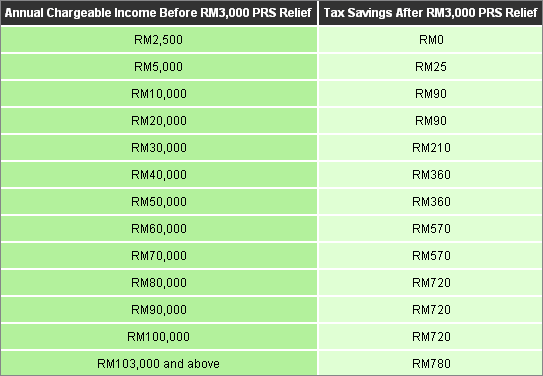
This is not the case, instead, think of the RM3,000 as the cap, if you invest RM3,001 in a PRS, you only get the relief of up to RM3,000. So, potentially an individual taxed at the highest rate can save up to RM780 per year in taxes if he/she contributed to a PRS. This however makes contributing more than RM3,000 a year unnecessary.

As per the table below, you will notice that the maximum savings an individual can get is RM780, if he is in the highest taxable bracket and is taxed at 26%.

PRS Tax Relief Table

PRS Youth Incentive

The PRS Youth Incentive is an initiative by the Malaysian government to encourage young Malaysians to start saving and investing for retirement. A one-off incentive of RM500 will be contributed by the Government to Malaysian individuals who qualify for the incentive.

Who is eligible?

  • Malaysian citizens only;
  • Aged between 20-30 years;
  • A minimum gross investment amount of RM1,000 must be accumulated in a single PRS fund of a single PRS provider within a calendar year, between 2014 till 2018

With the above-mentioned incentives, I myself have contributed RM3,000 every year to a Private Retirement Scheme through Fundsupermart. I chose them because prior to PRS, I’ve been investing in Unit Trusts and Mutual Funds through them. Everything is done online and is simple to follow. Some of the forms will require your signature and thus will be mailed/couriered to you. You may sign up for an account here and follow their instructions.

I chose to contribute to the PRS funds as seen below:

PRS Fundsupermart

There are a total of 8 PRS Providers:

  • Affin Hwang Asset Management Berhad
  • AIA Pension and Asset Management Sdn. Bhd.
  • AmInvestment Services Berhad
  • CIMB-Principal Asset Management Berhad
  • Kenanga Investors Berhad
  • Manulife Asset Management Services Berhad
  • Public Mutual Berhad
  • RHB Asset Management Sdn. Bhd.

The Disadvantages of a PRS

Yes, I invested in a PRS and the tax relief as well as the RM500 youth incentive wasn’t too bad. However, a Private Retirement Scheme is in essence a Unit Trust / Mutual Fund, and you know how much I hate them here in Malaysia as I’ve mentioned in my previous post Fundsupermart and Unit Trusts in Malaysia. The same ridiculous fees are charged by the providers regardless if you make a profit or a loss. Notice that my total profit averages to a measly 3.15% after 2 whole years, of course this is not including the tax relief afforded by the government.

Furthermore, your money is locked in until you reach the age of 55. Early withdrawal (with tax penalties) is allowed under some circumstances which are all specified at the PPA’s website.

Conclusion

All that being said, I will still continue to contribute RM3,000 each year solely because of the tax relief which I view as a guaranteed return provided by Putrajaya. I am in no way put off by the long wait till I’m 55 because I have surplus savings. However, the same cannot be said for my fellow Malaysians out there who are struggling to make ends meet.

Will you continue to contributed to a PRS this year? Have you taken advantage of the tax incentives provided by our Government?

Thank you for reading.

Share this:

  • Share on Facebook (Opens in new window) Facebook
  • Share on X (Opens in new window) X
  • Share on Reddit (Opens in new window) Reddit
  • Email a link to a friend (Opens in new window) Email
  • Share on WhatsApp (Opens in new window) WhatsApp
  • Share on LinkedIn (Opens in new window) LinkedIn

IGB REIT – Annual Report 2015

By Leigh
Updated October 30, 2016 Filed Under: Dividends, Companies in the News, Portfolio - Freedom Fund 4

IGB REIT Annual Report

What is a REIT?

So first and foremost, what is a Real Estate Investment Trust (REIT)? A REIT is a company that owns, and in most cases, operates income-producing real estate. They are listed on the KLSE and its shares are open to the public to purchase.  Learn more about them here in my Complete Guide to REITs in Malaysia.

Now, on to one of my favorite REITs – IGB REIT.

IGB REIT

IGB REIT Annual Report

I was awaiting the arrival of the dividend voucher from IGB REIT when to my surprise, it came together with its annual report in the form of a CD. Personally, I like how companies are mailing their annual reports in a CD instead of the old days when they printed thick copies of the reports and mailed those to every single shareholder.

Before we go into the details, you may download and open IGB REIT’s annual report here: IGBReit AR15

For the benefit of those who don’t know, IGB REIT’s property portfolio consists of Mid Valley Megamall and The Gardens Mall in the Klang Valley. Their main shareholders are IGB Corporation Berhad and Goldis Berhad whose main shareholders are the family of IGB Corp’s co-founder the late Datuk Tan Kim Yeow.

I will attempt to brief everyone on some of the more significant details of IGB REIT.

Balance Sheet

Dear shareholders of IGB REIT, these are yours.

IGB REIT The Gardens Mall

Photo Source: thisismetrixit.blogspot.com

IGB REIT Mid Valley Megamall

Photo Source: mapio.net

There were no significant changes in the REIT’s assets and liabilities, value of the company’s investment properties stood at RM4.9 billion. Mid Valley Megamall is valued at RM3.61 billion and The Gardens Mall at RM1.28 billion by Henry Butcher as at 31 December 2015.

Cashflow

A Real Estate Investment Trust’s (REIT) main source of income comes from rentals and the company’s gross rental income increased by 7% in 2015 to RM380 million a year. I particularly liked that IGB REIT also managed to not only keep expenses low, they were able to reduce it by almost RM3 million a year.

However, a lower net profit was declared for 2015 mainly because there was no changes in the fair value of the REIT’s properties. Generally most properties held by REITs would have an increase in value every year, I am not concerned with this aspect of IGB REIT because fair value of properties are paper gains, the true value of a REIT comes from its rental income.

Apart from rental income, I’d like to bring your attention to their Other Income section mainly car park, advertising an kiosk rental. The REIT is rakin in RM44 million a year in parking fees alone, RM6 million for advertisements and a cool RM23 million from renting out kiosk booths. All of which have increased compared to 2014.

My Holdings

IGB REIT has been in my PORTFOLIO since July 2015 with my gross investment at RM1.3152. I’ve been adding to my position when the price was right. As of today (3/3/16), the market price is RM1.54, giving me an unrealized capital gain of 16.33%. I have also received dividend income from IGB REIT recently amounting to RM766.08. Total gains including dividends received stands at 20.93%.

At the current price, dividend yield for the REIT is still above 5%, I will consider disposing off some of my shares in IGB REIT when the yield dips below the 5% mark and will top up on the REIT depending on their next quarterly results.

Do you own any REITs in your investment portfolio? 

Thanks for reading.

Share this:

  • Share on Facebook (Opens in new window) Facebook
  • Share on X (Opens in new window) X
  • Share on Reddit (Opens in new window) Reddit
  • Email a link to a friend (Opens in new window) Email
  • Share on WhatsApp (Opens in new window) WhatsApp
  • Share on LinkedIn (Opens in new window) LinkedIn
  • « Go to Previous Page
  • Page 1
  • Interim pages omitted …
  • Page 7
  • Page 8
  • Page 9
  • Page 10
  • Page 11
  • Go to Next Page »

Primary Sidebar

Newsletter

  • Advertise & Hire Me
  • Disclosure & Privacy Policy
  • Disclaimer

Copyright © 2026 Dividend Magic


Loading Comments...