
Table of Contents
Short answer: most priority and premier banking programmes in Malaysia want between RM250,000 and RM300,000 in assets under management. The cheapest genuine entry is Bank Rakyat Xclusive at RM50,000, though it is the only one here without PIDM deposit protection. The most demanding is UOB Privilege Banking at RM500,000. Nine of the fifteen programmes will also let you in through a mortgage or a salary crediting arrangement instead of cash, which means you may already qualify without moving any money at all.
Which priority or premier banking programme in Malaysia is right for you?
Priority banking is the tier that sits above ordinary retail banking. You keep a certain amount of money with the bank, and in return you get a relationship manager, a separate lounge to sit in, better rates on selected products, and usually a premium credit card.
Whether that is worth having depends almost entirely on how much you use it. In my experience most people use it far less than they expected to when they signed up.
First, one thing worth clearing up, because it confuses a lot of people.
Priority and premier mean the same thing. There is no Bank Negara definition and no industry standard that puts one above the other. Each bank simply picked a word and trademarked it. HSBC went with Premier at RM300,000. Hong Leong went with Priority at the same RM300,000. AmBank Signature Priority takes RM200,000. UOB Privilege wants RM500,000. The word tells you nothing about the tier.
What does tell you something is the word – Private. This is where the real jump happens. Most banks consider you a Private Banking client once you hit around RM3-4 million or USD1 million.
So ignore the branding and look at the number.
I have been through several of these programmes myself. I am with CIMB Preferred now – mainly so I can get the best credit card (in my opinion): the CIMB Preferred Visa Infinite. I banked with Maybank before that and have been seriously thinking about going back. I was also an HSBC Premier customer and left, partly over rates and partly over a bond product I was sold that came close to costing me real money. That story is in the HSBC section and it is probably the most useful thing on this page.
I am weighing up Hong Leong Priority at the moment too, mostly because of one specific card benefit.
This guide is for anyone with roughly RM200,000 or more in cash and investments trying to decide where to consolidate, or wondering whether it is worth rearranging their finances just to qualify.
On that second question, my honest answer is usually no. I will explain why later on.
No bank has paid for a place in this article, and I say plainly where I think a programme is weak.
Priority and premier banking in Malaysia compared
Fall-below fees, family eligibility and card details sit in each bank’s section further down. I have given fall-below fees their own comparison, because that is where the real cost of these programmes hides.
Every mainstream programme, ranked by what it costs to get in. Figures as at August 2026.
| Bank and programme | Minimum to qualify | Other ways to qualify |
|---|---|---|
| Bank Rakyat Xclusive* | RM50,000 deposits | RM700,000 home financing-i, or RM50,000 card-i limit |
| UOB Wealth Banking | RM150,000 | None published |
| RHB Premier | RM200,000 | RM20,000 monthly salary via Joy@Work, AUM waived for year one |
| AmBank Signature Priority | RM200,000 | RM150,000 investment, RM1m home financing, or RM20,000 monthly salary. All need top-up to RM200,000 within 6 months |
| Affin Invikta | RM200,000 | RM15,000 monthly salary, RM800,000 mortgage, or RM200,000 hire purchase |
| CIMB Preferred | RM250,000 | RM1m home or business premises financing, or RM300,000 auto financing |
| Maybank Premier Wealth | RM250,000 investable assets | RM1m total financial assets, including financing |
| Bank Islam Premier Wealth | RM250,000 liquid AUM | Joint arrangement with spouse or immediate family |
| HSBC Premier | RM300,000 total relationship balance | RM1m Premier mortgage, RM20,000 monthly salary, or existing Premier status overseas |
| Hong Leong Priority | RM300,000 | Joint membership. Mortgage Plus balances excluded |
| OCBC Premier Banking | RM300,000 | None published |
| Public Bank Red Carpet Gold | RM300,000 | Open a Premier ACE Account from RM5,000 and top up to RM300,000 within 12 months |
| Alliance Privilege | RM300,000 | RM16,000 monthly salary via Alliance@Work |
| Standard Chartered Priority | RM350,000, assessed month-end | RM1m housing loans, RM23,000 monthly salary for 12 months, or invitation |
| UOB Privilege Banking | RM500,000 | None published |
*Bank Rakyat is not a PIDM member. Deposits there are not covered by deposit insurance. Every other programme here carries RM250,000 of PIDM protection per depositor.
Banking AUMs – Why RM300,000 at one bank is not RM300,000 at another
HSBC, Hong Leong, OCBC, Public Bank and Alliance all landed on exactly the same number.
That tells you they are pricing off each other rather than off what a customer at that level is genuinely worth. It also means those five have to compete on service and cards instead of entry price.
But the number is the easy part. What counts towards it is where these programmes actually differ, and this is the bit nobody explains properly.
Hong Leong counts only deposits, foreign currency accounts, unit trusts and structured products. No insurance, no takaful, and Mortgage Plus Current Account balances are explicitly excluded. Alliance counts deposits and investments but leaves out Savelink balances and regular-premium bancassurance. RHB excludes ASNB entirely.
At the other end, Standard Chartered counts cumulative paid bancassurance premiums towards your AUM. Public Bank counts single-premium investment-linked insurance. CIMB counts bancassurance and bancatakaful. AmBank only added bancassurance and bancatakaful to its definition on 1 August 2026, with regular premiums recognised annually and single premiums for one year only.
So if a decent chunk of your net worth sits in insurance or takaful, RM300,000 at Hong Leong is a far steeper ask than RM350,000 at Standard Chartered. Read the AUM definition before you look at the headline number.
UOB is worth understanding properly because it appears twice above. Wealth Banking at RM150,000 is the accessible tier and still comes with a dedicated advisor. Privilege Banking at RM500,000 is the real programme and the most expensive entry in the country. Then Privilege Banking+ at RM3 million, with RM500,000 of that in investments. Three rungs, and the gap between the first two is the widest of any bank here.
How to qualify for priority banking without moving all your savings
Nine of the fifteen programmes have an alternative route in. This is the part most people miss entirely.
If you already carry a sizeable mortgage, you may qualify right now without moving a single ringgit of savings. CIMB, AmBank, HSBC and Standard Chartered all take RM1 million in home financing. Affin only wants RM800,000, the lowest mortgage threshold here. Bank Rakyat wants RM700,000 in home financing-i.
Hardly anybody knows this and the banks are not advertising it, because they would much rather have your cash on their balance sheet than your debt.
Read the fine print though, because some of these are runways rather than doors. CIMB gives you Preferred status on RM1 million in financing for the first six months. Months seven to twelve you need RM200,000 in AUM. From year two, the full RM250,000. AmBank works the same way, with all three of its alternative routes requiring a top-up to RM200,000 within six months.
Standard Chartered has a quirk worth knowing. You need RM1 million in housing loans to get in, but only RM850,000 to keep their monthly service fee waived. So the bar to stay is lower than the bar to enter.
Salary crediting is the other underused route, and RHB is the most generous. Credit RM20,000 a month through Joy@Work and your entire AUM requirement is waived for the first year. Not reduced, waived. In year two you need the standard RM200,000. HSBC offers the same at RM20,000 monthly through Premier Payroll. Standard Chartered wants RM23,000, the highest here, also for 12 months. Alliance wants RM16,000 through Alliance@Work. Affin is cheapest at RM15,000.
If you earn well but your money is tied up in property or EPF, these routes are far more realistic than conjuring RM300,000 in spare cash.
Bank Rakyat Xclusive is the cheapest way in at RM50,000, with one serious caveat
It is fully Shariah-compliant, which makes it the only realistic option if you want Islamic priority banking without RM250,000. Members get a relationship manager, the Xclusive Explorer Credit Card-i, and access to a dedicated centre.
Now the part nobody else mentions. Bank Rakyat is not a PIDM member.
It is a cooperative bank regulated under the Development Financial Institutions Act rather than a licensed commercial bank, and PIDM’s own handbook lists it among institutions that are not covered. Every other programme in the table carries RM250,000 of deposit insurance per depositor. Bank Rakyat carries none.
That does not make it unsafe. It is government-linked and it is not going anywhere. But you are trading a statutory guarantee for an implicit one, and you should know that before you park RM50,000 there. I have seen at least one site incorrectly list Bank Rakyat as PIDM-protected.
The other catch is coverage. There are two Xclusive centres, at KL Sentral and Putrajaya. Outside the Klang Valley most of the service benefit evaporates. Compare that with Alliance, which runs 37 Privilege Centres nationwide on a RM300,000 requirement.
You will also see this programme quoted at RM250,000 or RM300,000 elsewhere. Both are wrong. They appear to trace back to a forum thread that also lists HSBC Premier at RM200,000 and Standard Chartered at RM250,000, neither correct for years. I have used Bank Rakyat’s own page.
What to do if you have between RM50,000 and RM200,000
You will see Maybank Privilege quoted at RM50,000 in comparisons like this one. I left it out of the table deliberately.
Privilege sits below Maybank Premier Wealth and it is really preferential retail banking. Some rate benefits, queue priority. You are not getting a relationship manager who knows your name or a serious wealth conversation. Entry is any combination of deposits and investments between RM50,000 and RM250,000, or loans and investments in the same range, and you need a Maybank2u Savers, Premier 1 or Premier Mudharabah account.
Alliance Personal at RM100,000 sits in much the same bracket, one rung below Alliance Privilege. UOB Wealth Banking at RM150,000 is the strongest of the three, which is why it made the table.
All three are sensible places to build from rather than end points.
One thing worth knowing about Maybank. Premier Wealth runs through the Private Banking Account, which itself only needs RM10,000 to open. New applicants get routed into a Premier 1 Account first and a relationship manager moves you across later. So the RM250,000 is a maintenance requirement rather than a cheque you write on day one, which makes it more approachable than the number suggests.
The tiers above priority banking, from RM1 million to RM3 million
Most programmes have another tier at RM3 million: HSBC Premier Elite, OCBC Premier Private Client, Standard Chartered Priority Private, UOB Privilege Banking+, Hong Leong Private Banking. AmBank Signature Priority Private sits around RM2 million.
Two are more reachable. Public Bank Red Carpet Elite is RM1 million. CIMB Private Wealth is RM1 million in AUM plus RM500,000 in wealth management or CASA, which makes it one of the easier private banking doors among the local banks.
Hong Leong also launched an invitation-only Visa Infinite Privilege card in July 2026 for ultra high net worth clients, sitting outside the standard Priority tier entirely.
Different conversation, and not one I have covered in detail here.
What is priority banking, and how does it differ from private banking?
Malaysian banks run three broad service tiers for individuals. Most people only ever see the first.
Priority banking vs ordinary retail banking
Ordinary retail banking is transactional. You queue, you use the app, and when something goes wrong you call a general line and explain your situation to whoever picks up.
Priority banking adds a named person and a shorter queue. In practice you get a relationship manager, access to a dedicated centre rather than the main branch floor, preferential pricing on selected products, and often an invitation-only credit card.
Two things worth knowing before you get excited.
The relationship manager is a salesperson with a target. A good one is genuinely useful and will save you money on rates and fees. A bad one calls you every other day about bad bank products ie. unit trusts and mutual funds. Both exist, and you do not get to choose which you are assigned.
And the premium card is not always automatic. At CIMB, AmBank, RHB and Bank Islam the card arrives as an invitation attached to membership. At Maybank Premier Wealth there is no specific card that comes with the programme, so you apply separately like anyone else. Worth checking before you assume the card is part of the deal, because for a lot of people the card is the main reason they are interested.
Priority banking vs private banking
Private banking is the tier above, and the jump is larger than the branding suggests.
Priority and premier banking in Malaysia starts around RM200,000 to RM300,000. Private banking generally starts at RM3 million, though CIMB Private Wealth at RM1 million in AUM plus RM500,000 in wealth management is a notably easier door, and Public Bank Red Carpet Elite sits at RM1 million.
The real difference is not the queue. It is what the bank can actually do for you.
Priority banking sells you products off the bank’s own shelf. A dozen unit trusts, some structured products, a bancassurance plan or two. Private banking gets you discretionary mandates, structured credit, offshore booking through Singapore or Labuan, and estate and succession work that involves lawyers rather than a brochure.
If someone tells you their priority banking gives them access to private banking services, what they usually mean is that the relationship manager will introduce them to a colleague.
Why banks offer priority banking at all
Because it works, for them.
Deposits are cheap funding, and a customer who consolidates everything in one place is far less likely to leave. But the real money is in fee income. Unit trust sales charges, bancassurance commissions, structured product spreads and foreign exchange margins earn the bank considerably more than the interest margin on your fixed deposit ever will.
You can see this in how the programmes are designed. Standard Chartered awards 40 reward points per RM10,000 you hold in investments, and only 5 per RM10,000 in fixed deposits. Eight times the reward for putting your money where the fees are. That is not an accident.
None of this is a reason to avoid these programmes. It is a reason to understand that the relationship manager who calls you is being paid to sell, and to treat the free lounge access as compensation for that rather than as a gift.
I have found the arrangement worth it. But only because I say no a lot.
What happens if your balance falls below the minimum?
This is the question nobody answers properly, and it is the one that actually costs people money.
Most comparisons list entry requirements and stop there. But your balance moves. You buy a property, you pay school fees, you have a bad year. What the bank does when that happens varies enormously, and it is worth knowing before you commit.
| Programme | Fee if you fall below | What actually happens |
|---|---|---|
| HSBC Premier | RM150 per month | Charged monthly while below RM300,000 |
| RHB Premier | RM150 every 3 months | Only if average daily balance is short in all three months of the cycle |
| Maybank Premier Wealth | RM800 per year | Only after 12 consecutive months below threshold |
| Standard Chartered Priority | Monthly fee, amount not published | Waived at RM350,000, or RM850,000 in housing loans |
| Public Bank Red Carpet Gold | None | Six months’ grace, then 21 days to top up, then 21 days’ notice before downgrade |
| AmBank Signature Priority | None | Termination or suspension with 90 days’ notice |
| UOB Privilege Banking | None | Downgrade to a lower tier |
| UOB Wealth Banking | None | Downgrade to Personal Banking two months after enrolment month |
| OCBC Premier Banking | None | Termination, suspension or downgrade with 14 to 21 days’ notice |
| CIMB Preferred | None published | Suspension or termination on 14 days’ notice |
| Hong Leong Priority | None | Membership terminated |
| Affin Invikta | May impose a charge | Terminated below RM200,000 |
| Alliance Privilege | None published | Loss of status and benefits, including the card fee waiver |
| Bank Islam Premier Wealth | None found | Not published. Check with the bank |
| Bank Rakyat Xclusive | None found | Not published. Check with the bank |
Only three programmes charge a fee you can put a number on
HSBC is the harshest. RM150 a month, every month you are below RM300,000. Slip under for a year and that is RM1,800. No grace period.
RHB charges RM150 every three months, but only if your average daily balance falls short in all three months of the cycle. One good month resets it. That is a meaningfully fairer structure.
Maybank is the most forgiving of the three at RM800 a year, and only after twelve consecutive months below the threshold. You have a full year to recover before anything is charged.
Standard Chartered confirms in its terms that a monthly service fee applies. Waived if you hold RM350,000 in deposits or investments at month end, or RM850,000 in housing loans. I would ask for the figure in writing before joining.
Everyone else just takes your status away
No fee, but you lose the relationship manager, the centre access, the preferential rates, and in most cases the credit card.
That last part matters more than people expect. At Alliance, the lifetime annual fee waiver on your credit card is tied to maintaining Privilege membership. Lose the status and the fee comes back.
The notice periods vary a lot. Public Bank is the most generous by a wide margin: six consecutive months below the minimum, then 21 days to top up, then a further 21 days’ written notice before they downgrade you. That is close to eight months of runway.
AmBank gives 90 days’ notice. OCBC gives 14 to 21 days. CIMB gives 14 days. Hong Leong and Affin simply terminate.
UOB downgrades rather than terminates, which is the gentlest outcome here. Fall below RM500,000 on Privilege Banking and you drop a tier rather than losing everything. Wealth Banking members who fall below RM150,000 drop to ordinary Personal Banking two months after their enrolment month.
How the balance gets measured matters as much as the number
Three different methods are in use and they are not equivalent.
Standard Chartered, CIMB and OCBC use a month-end snapshot. If your money is out of the account on the last day of the month, you fail, even if it was there for the other thirty days.
RHB uses average daily balance, which is more forgiving and harder to game.
Maybank and Public Bank look at consecutive months, which effectively gives you a rolling grace period.
If your income is lumpy, or you move money for property deals and business, the month-end snapshot banks are the ones to be careful with. I would rather have RHB’s average daily balance than CIMB’s month-end reading, even though CIMB has no published fee at all.
Premier banking – What counts towards your AUM?
Every programme in this article is priced in “AUM”, which stands for assets under management. Some banks call it TRB, or total relationship balance. Maybank talks about investable assets and total financial assets. They all mean roughly the same thing: the money the bank counts as yours when deciding whether you qualify.
The catch is that no two banks count the same way. This is where people get caught out, and it is the single most useful thing to check before you apply.
What usually counts?
Current and savings accounts. Fixed deposits and term deposits-i. Unit trusts and unit trust-i. Bonds and sukuk. Structured investments and products. Foreign currency accounts.
Those are the safe assumptions. Everything below is where it gets messy.
Insurance and takaful: the biggest variable
This is where RM300,000 in one bank differs from RM300,000 in another.
Hong Leong counts no insurance at all. Their AUM definition covers deposits, foreign currency, unit trusts and structured products, full stop.
Standard Chartered goes the other way and counts cumulative premiums paid, less any partial withdrawals, as part of your investment holdings.
Public Bank counts single-premium investment-linked policies. Alliance excludes regular-premium bancassurance and also excludes Savelink balances. CIMB counts bancassurance and bancatakaful.
AmBank only added bancassurance and bancatakaful to its definition on 1 August 2026, and the treatment is uneven: regular premiums are recognised in full annually, but single premiums count for one year only.
So if a large chunk of your net worth sits in insurance, Standard Chartered at RM350,000 may be easier to reach than Hong Leong at RM300,000. Read the definition, not the headline.
ASNB, EPF and the things that usually do not count
RHB explicitly excludes ASNB. AmBank excludes both fixed price and variable price ASNB funds from certain campaigns. Practice varies elsewhere and most banks do not publish a clear answer, so if a meaningful part of your money sits in ASNB and ASM investments, ask before you assume it counts.
EPF does not count anywhere. It is a statutory fund, not a bank-held asset, and no bank in this comparison treats it as AUM. Worth saying because a lot of Malaysians have more in EPF than anywhere else and reasonably wonder.
Property equity does not count either, though several banks will let the mortgage itself qualify you, which is a different mechanism covered earlier.
Hong Leong specifically excludes Mortgage Plus Current Account balances, which catches people who assume their offset account is helping.
Some other things worth confirming
Share trading accounts, PRS, gold investment accounts and cash management accounts are treated inconsistently and most banks do not spell it out in their published terms. If any of these represent a big share of your assets, get it confirmed in writing rather than relying on what a comparison table says. Including this one.
Fresh funds versus existing funds
Two different rules that get conflated.
Qualifying for membership generally accepts money you already hold at the bank. Moving RM100,000 from your existing savings into a fixed deposit at the same bank usually still counts towards the threshold.
Welcome offers and promotional rates are a different matter. Those almost always require fresh funds, meaning money transferred in from another institution, and the bank will typically earmark it for a set period. Shift it out early and you lose the promotional rate, sometimes retroactively.
The practical implication: you can often qualify for the programme without moving anything, but you cannot claim the sign-up bonus that way. Banks are much clearer about the second rule than the first.
Why this section matters more than the entry requirement
If you are close to the line at two different banks, the AUM definition decides which one you actually get into. I have seen people apply to Hong Leong on the strength of an insurance-heavy balance sheet and get turned down, then walk into Standard Chartered with the same money and qualify comfortably.
What benefits do you actually get?
Here is my honest ranking of these benefits, from the ones worth having to the ones that are mostly decoration.
Airport lounge access, the most underrated benefit
This is the one that pays for itself, and it is the reason most people I know stay in these programmes. Do note that these are usually tied to a special credit card offered to a bank’s priority clients.
A Plaza Premium Lounge walk-in at KLIA costs real money. Eight visits a year, which is what CIMB Preferred and Standard Chartered Priority both offer, is worth more than most of the other benefits combined if you fly even moderately.
The numbers vary a lot though, and so do the conditions.
RHB Premier is attractive. Twelve visits a year with just RM1,000 spent in the prior calendar month, or unlimited access if you spend RM100,000 a year on the card. Unlimited lounge access at a RM200,000 entry point is the best value in this comparison and almost nobody talks about it.
CIMB is a standout – they give eight visits in total, but from 1 July 2026 they are capped at four per half year, and you can share them with your supplementary cardholders. Also, their lounge access is for the higher end lounges.
AmBank scales with your balance, which is unusual. Unlimited at RM500,000 and above for both principal and supplementary cardholders. Eight a year between RM200,000 and RM499,999, principal only, and each visit needs RM1,000 of spend in the prior month.
HSBC gives six. Public Bank gives five, each requiring RM1,000 of spend within a 30 day window. Affin gives twelve with an RM3,000 monthly spend condition. OCBC gives four. Hong Leong gives four.
UOB’s Visa Infinite Metal still gives unlimited access for the principal cardholder, but supplementary cardholders lost complimentary access on 1 March 2026. Worth knowing if you were joining on the strength of an older review.
Watch for two traps. Guest access is rarely included, and Standard Chartered charges USD29 per person for guests and for any visit beyond your allowance. And a minimum spend condition attached to lounge access turns a free perk into a spending requirement.
Preferential rates, worth having if you actually negotiate
Fixed deposit rates above board rate, better foreign exchange spreads, discounted unit trust sales charges.
The unit trust discounts are the most concrete. RHB offers 1% on unit trusts and 0.5% on PRS for Joy@Work Premier customers through 2026, against a normal sales charge of 5% to 6%. On a RM100,000 purchase that is a saving of RM4,000 or more.
FX spreads matter if you deal in currency regularly. If you convert twice a year for holidays, the improvement is measured in tens of ringgit and you should ignore it.
The important thing is that preferential rates are usually negotiated rather than automatic. The rate you get depends on whether you ask and how much you hold. People who never ask get board rate and assume the benefit does not exist.
The relationship manager, genuinely useful or genuinely annoying
Nothing in these programmes varies more than this.
A good relationship manager gets your loan approved faster, sorts problems in one phone call, tells you when a rate is available, and gets fees waived. That has real value.
A bad one is a salesperson who calls when a new product launches, and every conversation ends with a recommendation.
You do not choose which you get, and they change jobs often. I have had both. My current CIMB relationship came through a referral, which is generally the best way to end up with someone competent, and I am happy to pass on the contact if it helps.
The banks are repositioning around this. Hong Leong announced a shift to an advisory-led model in February 2026, moving away from product-based selling towards outcome goals like preservation, income, growth, diversification and legacy. If that is delivered rather than just announced, it is the most meaningful change any of these programmes has made in years.
Priority branch service, better than it sounds
Easy to dismiss until you need it.
A dedicated centre where someone knows your name, rather than a numbered ticket at a busy branch, is worth something on the day you need a banker’s cheque urgently or you are sorting a property transaction.
But coverage is wildly uneven and this is where the local banks win. Alliance has 37 Privilege Centres nationwide. Public Bank and Maybank have the branch networks to match, Maybank being Malaysia’s largest bank with the most branches. Bank Rakyat has two Xclusive centres, both in the Klang Valley.
If you are in Penang, JB or Kuching, ask where the nearest centre actually is before you join. A relationship manager you can only reach by phone is worth considerably less.
Premium credit cards, but check whether you actually get one
Cards are the most tangible benefit and the reason a lot of people join.
At CIMB, AmBank, RHB and Bank Islam, an invitation-only card comes with membership. Alliance goes further and waives the annual fee for life while you maintain Privilege status.
At Maybank Premier Wealth there is no specific card attached to the programme. You apply separately, same as anyone else. Worth knowing if the card was the plan.
And some of the best cards in Malaysia need no priority relationship at all. The Hong Leong Visa Infinite earns 1.0 mile per ringgit on dining, uncapped, no minimum spend, free for life, and requires only RM150,000 in annual income. No AUM, no membership. I go into this properly in the best credit cards in Malaysia guide.
Check what card you would actually get, and whether you could get something similar without moving your money.
International and regional banking, only if you need it
Genuinely differentiated, and only for a specific group of people.
HSBC is the strongest here. Premier status is recognised across the HSBC network, so existing Premier status overseas qualifies you in Malaysia and vice versa. Useful for anyone moving between countries or with children studying abroad.
Standard Chartered has Global Recognition across its network, plus pre-arrival account opening in other countries and a fee waiver on ATM withdrawals up to RM10,000 equivalent daily.
CIMB has the ASEAN network. You can withdraw up to USD10,000 daily at branches in Malaysia, Singapore, Indonesia or Cambodia from your home country account. OCBC gives access to 76 Premier Banking Centres across Southeast Asia. UOB is strong regionally too.
If you never leave Malaysia, none of this matters and you should weight it at zero.
Family benefits, where the differences are largest
Family provisions range from excellent to nonexistent, and this is worth a close look if you have a spouse or adult children.
Maybank Premier Heritage extends full Premier status to your spouse and children up to age 30, which puts it level with HSBC and ahead of everything else here. This is one of the two reasons I am considering going back.
HSBC extends Premier benefits to one legal spouse and all children until their 30th birthday, with no separate AUM requirement, provided you maintain RM300,000.
Standard Chartered’s Household Recognition covers parents, spouse and children with no age limit at all, which sounds better than HSBC until you read the detail. Accounts are not pooled for eligibility, and what family actually get is centre access, priority counters, the service line, preferential pricing and lifestyle offers. No card, no lounge access. Service recognition, not full status.
RHB, OCBC and CIMB all allow up to three family members, but each needs their own minimum. RHB wants RM200,000 from a spouse or RM400,000 jointly, and RM50,000 from a child. OCBC wants RM50,000 each. AmBank allows two, restricted to spouse and children up to 21.
Hong Leong is the strictest. One secondary member at the same RM300,000, and every additional member raises the requirement by another RM300,000.
Affin and Bank Rakyat have no family programme at all.
Lifestyle privileges, mostly decoration
Parking, concierge, golf, dining discounts, health screening, will writing.
Some of this is real. Golf privileges genuinely matter if you play. Public Bank offers 35% off will and wasiat writing, which is a proper discount on something everyone should do. Complimentary green fees across multiple countries are worth having if you use them.
Most of it is not. Concierge services are a phone number you will call once. Dining discounts are available on plenty of ordinary cards. Parking privileges apply at a handful of buildings.
Do not let this section influence your decision. It is the part of the brochure with the nicest photographs and the least value.
All priority banking programmes in Malaysia rated
| Programme | Entry | Rating | In one line |
|---|---|---|---|
| CIMB Preferred | RM250k | 4.5 | Best lounge quality. The only Plaza Premium First access, with no spend conditions |
| RHB Premier | RM200k | 4.5 | Best value. Lowest entry, fairest terms, most generous salary route |
| Alliance Privilege | RM300k | 4 | Most underrated. 37 centres nationwide and cards free for life |
| AmBank Signature Priority | RM200k | 4 | Best at RM500k. Only unlimited lounge access below RM3 million |
| Affin Invikta | RM200k | 4 | Four ways to qualify and 2.2% on your parked cash. No family option |
| Maybank Premier Wealth | RM250k | 3.5 | Best for families and branch access. No credit card comes with it |
| HSBC Premier | RM300k | 3.5 | Unbeatable internationally. Harshest fall-below fee and only three centres |
| Public Bank Red Carpet Gold | RM300k | 3.5 | The safe choice. Eight months of grace and the easiest soft entry |
| UOB Privilege Banking | RM500k | 3 | Good product, bad pricing. Their RM150k tier gets you most of it |
| Hong Leong Priority | RM300k | 3 | Most upside if the advisory pivot is real. Tightest AUM rules today |
| Standard Chartered Priority | RM350k | 3 | Friendliest AUM definition, but guests cost USD29 and the fee is unpublished |
| Bank Islam Premier Wealth | RM250k | 3 | Strongest fully Shariah option, let down by thin documentation |
| Bank Rakyat Xclusive | RM50k | 3 | Cheapest way in and a free card, but no PIDM protection at all |
| OCBC Premier Banking | RM300k | 2.5 | Excellent card for overseas spend, thin programme around it |
How I arrived at these ratings
Ratings in articles like this are usually meaningless, so here is exactly what mine are based on.
What you get relative to what you put in. A programme asking RM200,000 and delivering twelve lounge visits is doing better than one asking RM500,000 for the same. This is the heaviest factor by some distance.
The card. For most people the credit card is the benefit they use most often, so the annual fee, the waiver conditions, the lounge count and the earn rate matter more than anything in the brochure.
How the bank treats you when things go wrong. Fall-below fees, notice periods, how the balance gets measured. A programme that charges RM150 the month you dip is worse than one giving you six months to recover, even if the benefits look identical on paper.
Access. How many centres, and where. A strong programme you can only reach from the Klang Valley is not a strong programme if you live in Penang.
What I deliberately do not weight much: lifestyle privileges, concierge services, and anything that appears in a brochure alongside a photograph of a golf course.
The bands mean this:
5 stars. Worth restructuring your banking for. Nothing here earns five.
4 to 4.5. Strong. If you are near the threshold, worth doing.
3 to 3.5. Fine. Take it if you already bank there, do not move money for it.
2 to 2.5. Weak for what it asks. Something else does this better for less.
Below 2. Avoid unless you have a specific reason.
Two programmes share the top spot for different reasons. RHB Premier wins on value, giving you the most for the least. CIMB Preferred wins on quality, with the only Plaza Premium First access in this comparison and no spending conditions attached. Which is right for you depends on whether you would rather fly more often or fly better.
Two honest limitations before we get into it.
I have first-hand experience with four of these fourteen programmes: CIMB Preferred, Maybank, HSBC Premier and Hong Leong Priority. Everywhere else I am working from published terms, and I say so in each review rather than pretending otherwise. Published terms tell you what a bank promises. They do not tell you whether your relationship manager returns calls.
And service quality varies more by individual relationship manager than by bank. Two people at the same programme can have completely different experiences. These ratings judge the programme, not your luck.
Priority and premier banking reviews, bank by bank
CIMB Preferred

| CIMB Preferred | At a glance |
|---|---|
| Minimum to qualify | RM250,000 in deposits, investments or bancassurance/bancatakaful |
| Other ways in | RM1m home or business premises financing, or RM300,000 auto financing |
| Fall-below fee | None published. Suspension or termination on 14 days’ notice |
| How balance is measured | Month-end snapshot |
| Family eligibility | None published. |
| Premium card | CIMB Preferred Visa Infinite. Invitation-only, free for life |
| Lounge access | Up to 8 total Plaza Premium First and Plaza Premium visits worldwide. Capped at 4 per half year, shared with your nominee |
| International banking | ASEAN network. Up to USD10,000 daily withdrawal at branches in Malaysia, Singapore, Indonesia and Cambodia |
| My rating | 4.5 stars |
CIMB Preferred’s lounge access, the reason most people are here
- 8 visits per year to over 150 selected Plaza Premium First and Plaza Premium Lounges worldwide
- Capped at 4 visits per half year, changed from a flat 8 in the 2026 revision
- Visits are shared between the primary holder and the supplementary holder, not 8 each
- Includes Plaza Premium First at KLIA Terminal 1, the best lounge in Malaysia and the single best use of this card
- No minimum spend condition. Access is maintained purely by holding RM250,000 in AUM
- Also covers Sky Lounge and Sky Lounge Xpress at SkyPark Subang, but this one needs RM2,000 spend in the same month, valid to 31 January 2027
- Current benefit runs 1 July 2026 to 30 June 2027
Overview
RM250,000 puts CIMB in the middle of the pack, and the card is the reason to be here. Free for life, no spend conditions on lounge access, and Plaza Premium First at KLIA, which very few cards offer.
The mortgage route is staged rather than permanent. RM1 million in financing covers you for six months, then RM200,000 in AUM to month twelve, then the full RM250,000 from year two.
There is no CASA requirement for membership, despite what several sites claim. The RM50,000 CASA figure belongs to the card’s bonus points campaign, which needs RM10,000 monthly spend, RM250,000 AUM, and RM50,000 sitting in CASA. That last condition costs you roughly RM1,250 a year in foregone fixed deposit interest, so do the maths before chasing the points.
My experience with CIMB Preferred
This is my current bank.
The lounge access is what I actually use, and the important part is that it is maintained passively through AUM. Several competitors make you spend RM1,000 in the prior month before each visit, which turns a benefit into a chore. CIMB does not, and that is worth more than an extra visit or two.
The half-yearly cap caught me out this year. Eight visits sounds like eight visits until you discover they are four per half year. I found that out while planning a trip, which is not the ideal moment.
I got in through a relationship manager referral, which is generally how you end up with someone competent rather than whoever is next on the rota. That route is no longer available, but I am happy to pass the contact on.
The ASEAN withdrawal facility has got me out of trouble more than once. Pulling USD10,000 a day from your Malaysian account at a Singapore or Jakarta branch is genuinely useful.
Pros
Plaza Premium First at KLIA, which almost nothing else here offers. No spend conditions on lounge access. Card free for life. Real ASEAN network with USD10,000 daily cross-border withdrawals. No published fall-below fee. Nominees can include parents. Preferential FX at CIMB exchange booths.
Cons
Lounge allowance split four per half year and likely shared with your nominee. Month-end snapshot is unforgiving if your cash moves. Fourteen days’ notice before suspension, the shortest here. Nominees need their own AUM for full card benefits. The lounge benefit expires June 2027 and has now been trimmed twice.
My verdict on CIMB Preferred
4.5 stars, and the one I chose for myself. Best balance of entry requirement, card quality and regional usefulness at this level.
Worth it if you fly out of KLIA and want lounge quality over quantity, or if you already carry a large CIMB mortgage. Less suitable if your balance hovers near RM250,000, since the month-end reading and 14-day notice are the harshest combination here, or if you and your spouse both travel and need more than four visits per half year.
Not five stars because CIMB has quietly reduced the lounge benefit twice in short order, and a benefit that keeps shrinking is worth less than the same benefit from a bank that leaves it alone. The half-yearly cap and the shared allowance are real limitations rather than technicalities.
RHB Premier

| RHB Premier | At a glance |
|---|---|
| Minimum to qualify | RM200,000 |
| Other ways in | RM20,000 monthly salary via Joy@Work, with the AUM requirement fully waived for year one |
| Fall-below fee | RM150 every three months, and only if your average daily balance is short in all three months |
| How balance is measured | Average daily balance, the fairest method here |
| Family eligibility | Up to 3 members. Spouse needs RM200,000 own or RM400,000 joint. Children under 28 need RM50,000 or RM250,000 joint |
| Premium card | RHB Premier Visa Infinite, and Visa Infinite-i. Invitation-only, no annual fee |
| What does not count | ASNB is explicitly excluded |
| My rating | 4.5 stars |
Lounge access
- Unlimited Plaza Premium and Aerotel access with RM100,000 of annual retail spend
- Otherwise up to 12 visits a year, needing RM1,000 of spend in the prior calendar month
- Covers Malaysia, Singapore, Hong Kong, Taiwan, Indonesia, the Philippines, Cambodia, Australia, England and China
- Principal and supplementary cardholders share the quota
- Does not include Plaza Premium First at KLIA Terminal 1, so lounge quality sits below CIMB
- Guests get 25% off in Malaysia
- Travel insurance up to RM2 million
- Complimentary green fees at selected Selangor clubs with RM5,000 of statement spend
- Islamic variant available as the Premier Visa Infinite-i with identical terms
Overview
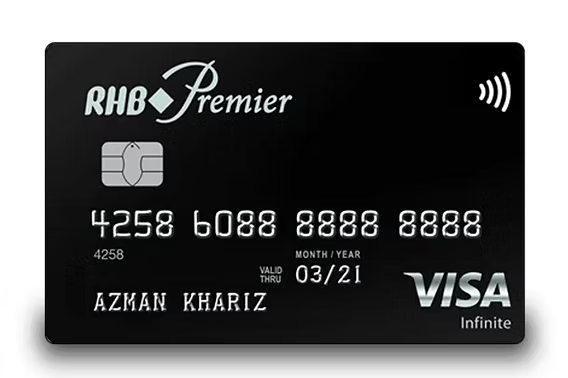
On paper this is the best value in Malaysian priority banking, and it is not close.
RM200,000 is the joint lowest genuine entry here. For that you get twelve lounge visits, which is more than CIMB at RM250,000, more than HSBC at RM300,000, and equal to UOB at RM500,000. The condition attached is only RM1,000 of spend in the prior calendar month, which anyone carrying a premium card will hit without thinking about it.
Spend RM100,000 a year and the twelve becomes unlimited. Unlimited lounge access at a RM200,000 entry requirement does not exist anywhere else in this comparison.
The Joy@Work route is the most generous alternative entry in this article. Credit RM20,000 a month and your entire AUM requirement is waived for the first year. Not reduced, waived.
RHB is also running discounted sales charges for Joy@Work Premier customers through 2026: 1% on unit trusts and 0.5% on PRS, against a normal 5% to 6%. On a RM100,000 purchase that saves you RM4,000 or more. It is the most concrete rate benefit I could verify anywhere in this comparison.
The fall-below treatment is the fairest here too. RM150 every three months, charged only if your average daily balance falls short in all three months of the cycle. One good month resets it. HSBC takes RM150 every month regardless. Hong Leong just terminates you.
One thing to be aware of before you move money here. The standard RHB Visa Infinite offers the same lounge structure, unlimited at RM100,000 of annual spend or 12 visits at RM1,000 monthly, and it also carries no annual fee. It needs only RM150,000 in annual income and no priority banking relationship at all.
What Premier membership adds on the card side is a wider lounge country list. The standard card emphasises Malaysia and Singapore, while the Premier version covers nine countries and more. Real, but narrower than the marketing suggests.
So join RHB Premier for the RM200,000 entry, the Joy@Work salary waiver, the unit trust discounts and the fair fall-below terms. Not solely for the card.
Two genuine weaknesses.
ASNB is explicitly excluded from AUM. For a lot of Malaysians, ASB and ASM are a meaningful share of liquid wealth. If that is you, RM200,000 here may be harder to reach than RM250,000 at CIMB.
The family terms are tighter than the headline. Three members sounds generous until you read that a spouse needs RM200,000 of their own or RM400,000 joint. This is recognition for families who are already wealthy, not an extension of your status to dependents. Maybank and HSBC do it properly.
Pros
Joint lowest entry here. Twelve lounge visits on only RM1,000 of prior-month spend, unlimited at RM100,000 annual spend. Wide footprint across nine countries. Most generous salary route in this comparison. Fairest fall-below terms with a three-month test. Average daily balance rather than a month-end snapshot. Verified unit trust and PRS discounts through 2026. Islamic card variant available.
Cons
ASNB explicitly excluded from AUM, a real problem for many Malaysians. Family members need substantial AUM of their own. Children covered only to 28, against 30 at HSBC and Maybank. Guests pay 75% rather than entering free. The unlimited tier needs RM8,300 of monthly spend.
The standard RHB Visa Infinite offers the same lounge structure with no annual fee and no AUM requirement, so membership buys a wider lounge list rather than a better card. Principal and supplementary cardholders share the quota. Card earn rates were devalued and are no longer market-leading.
My verdict on RHB Premier
Four and a half stars, joint highest here alongside CIMB Preferred, but earned for the programme rather than the card.
Lowest entry requirement, best lounge allowance relative to that requirement, fairest fall-below terms, most generous salary route, and the only concrete rate discounts I could verify. That combination is hard to argue with.
Worth it if you fly more than a few times a year, if you earn RM20,000 a month and want a free year, or if your balance moves around and you want somewhere safe to sit near the line.
What keeps it off five is the ASNB exclusion, family terms requiring your spouse to be independently wealthy, no Plaza Premium First access, and the fact that the standard RHB Visa Infinite gets you most of the lounge benefit for nothing.
If you have RM200,000 and want the most programme value per ringgit, this is where I would look first. If you only want the lounge access, apply for the standard card instead.
Alliance Privilege

| Alliance Privilege | At a glance |
|---|---|
| Minimum to qualify | RM300,000 in eligible deposits and/or investments |
| Other ways in | RM16,000 monthly salary via Alliance@Work |
| Fall-below fee | None published. You lose status and benefits, including the card fee waiver |
| What does not count | Savelink balances and regular-premium bancassurance |
| Family eligibility | Up to 3 joint account holders, with privileged status extended to family |
| Premium card | Alliance Privilege Visa Signature, plus access to the Alliance Bank Visa Infinite |
| Card annual fee | Waived for life while you maintain Privilege membership |
| Privilege Centres | 37 nationwide, the widest coverage here |
| My rating | 4 stars |
Lounge access
- 4 Plaza Premium and Plaza Premium First visits a year on the Privilege Visa Signature, plus 2 Travel Club Lounge visits
- 2 airport e-hailing rides worth RM80 each, subject to RM120,000 of annual spend, principal cardholder only
- The Alliance Bank Visa Infinite is the more interesting card. RM438 principal fee, waived for life for Privilege members since 1 August 2025, with the previous minimum-spend condition removed entirely. Supplementary fees waived too
- On the Visa Infinite you get 2 Plaza Premium visits and 1 Travel Club visit in year one. From year two, unlimited access to both networks if you spend RM120,000 annually. Miss that and you stay on 3 visits a year
- Visa Infinite lounge access is principal cardholder only, with guests getting 25% off in Malaysia and 20% overseas
- 10x bonus points on overseas spend, 1x domestic, uncapped and never expiring. The old 8x on e-commerce and e-wallets was removed on 1 August 2025
- Up to 8% cashback on the Visa Signature: 5% base, plus 3% more if you spend RM120,000 a year and hold RM300,000 average AUM
Overview
Alliance is the programme I most underestimated before checking properly, and it deserves better than its reputation.
Start with coverage, because it is the thing nobody mentions. 37 Privilege Centres nationwide. HSBC has three, all in the Klang Valley, on the same RM300,000. Bank Rakyat has two. If you live in Penang, Ipoh, Kuching or Johor Bahru, Alliance will actually serve you in person, and that is worth more than a marginally better lounge allowance.
Then the fee position. Both cards are waived for life while you maintain membership, and Alliance removed the minimum-spend condition on the Visa Infinite waiver in August 2025. That is unusually clean. Most banks either charge a fee or attach spend conditions that quietly reappear.
The cashback is genuinely competitive at up to 8%, though the top rate needs RM120,000 of annual spend and RM300,000 of average AUM together. The base 5% is the useful number for most people, and it beats the 0.3% to 1% cashback rates elsewhere in this comparison comfortably.
The Alliance@Work route at RM16,000 monthly salary is the second cheapest salary door here after Affin. Worth noting there appear to be two different Alliance arrangements: the RM16,000 salary route on the Privilege page, and a separate employer-scheme concession giving Privilege membership at RM100,000 AUM. If you work for a company on Alliance@Work, ask which applies to you.
Two weaknesses.
The AUM definition excludes two things people commonly hold. Savelink balances and regular-premium bancassurance both fall outside it. If your money sits in either, check before applying.
The best benefits need RM120,000 of annual spend. The extra 3% cashback and the e-hailing rides both require it. That is RM10,000 a month, which most people at RM300,000 in AUM will not hit.
The unlimited lounge access on the Visa Infinite is real, and it is the most overlooked benefit in this whole comparison. From year two, spend RM120,000 annually and you get unlimited Plaza Premium and unlimited Travel Club access. Miss the threshold and you drop to three visits a year, which is poor. So this is a card that rewards heavy spenders and punishes light ones.
Also worth knowing that the Privilege Visa Signature is the card with Plaza Premium First access, not the Visa Infinite. That is unusual, since the Infinite is the more premium product on paper, and it means the two cards are worth holding for different reasons.
Pros
37 Privilege Centres nationwide, by far the widest coverage in this comparison. Both cards waived for life while you maintain membership, with no spend conditions on the waiver. Up to 8% cashback, and 5% base is strong against everything else here. Salary route at RM16,000. Up to 3 joint account holders with status extended to family. Travel Club Lounge access is something no other programme here offers.
Unlimited Plaza Premium and Travel Club access on the Visa Infinite from year two at RM120,000 annual spend. 10x points on overseas spend, uncapped and non-expiring.
Cons
Without RM120,000 of annual spend, the Visa Infinite drops to just 3 lounge visits a year, among the worst here. Visa Infinite lounge access is principal cardholder only, with no supplementary access at all. Savelink and regular-premium bancassurance excluded from AUM. The top cashback rate and the e-hailing benefit both need RM120,000 of annual spend. No published fall-below fee but losing status also loses your card fee waiver, which is a real cost. Family provision works through joint accounts rather than a proper heritage programme.
My verdict on Alliance Privilege
Four stars, and the most underrated programme in this article.
It wins on the two things comparison tables systematically undervalue: branch coverage and card fees. 37 centres nationwide against HSBC’s three at the same entry requirement is not a small difference, and a lifetime fee waiver with no spend conditions is cleaner than what most competitors offer.
Worth it if you live outside the Klang Valley and want a relationship manager you can actually visit, or if you spend RM120,000 a year on cards. At that level the unlimited lounge access plus a card that is free for life makes Alliance competitive with anything here, including RHB.
Less suitable if lounge access is your priority, since without RM120,000 of annual spend you drop to three visits at lower entry requirements. And check the AUM exclusions before applying if you hold Savelink or regular-premium insurance.
AmBank Signature Priority

| AmBank Signature Priority | At a glance |
|---|---|
| Minimum to qualify | RM200,000 primary AUM |
| Other ways in | RM150,000 investment, RM1m home financing, or RM20,000 monthly salary. All require top-up to RM200,000 within 6 months |
| Fall-below fee | None. Termination or suspension with 90 days’ notice |
| What counts as AUM | Bancassurance and bancatakaful added 1 August 2026. Regular premiums recognised annually, single premiums for one year only |
| Family eligibility | Maximum 2 supplementary members, spouse and children up to age 21 |
| Premium card | AmBank Signature Priority Banking Visa Infinite. Invitation-only, free for life. First 3 supplementary cards free, fourth onwards RM188 |
| Tier above | Signature Priority Private, around RM2 million |
| My rating | 4 stars |
Lounge access
Access scales with your balance, which is unusual and worth understanding:
- RM500,000 and above: unlimited visits, principal and supplementary
- RM200,000 to RM499,999: 8 visits a year, principal only
- Below RM200,000: 6 visits a year
- At every tier you must spend RM1,000 in the calendar month before each visit. So to use a lounge in March, you need RM1,000 of spend in February. This is the condition most write-ups miss
- Plaza Premium coverage across over 40 countries including London, Hong Kong and Taiwan, with a three-hour stay
- RM2 million travel insurance covering you and your family members when the full airfare is charged
- The invitation-only Metal Visa Infinite adds integrated LoungeKey access and immigration fast-track at discounted rates, bookable 72 hours ahead
Overview
The only programme here where lounge access scales with your balance, and the only one offering unlimited access at RM500,000 rather than RM3 million.
That makes AmBank the direct answer to UOB. Both want RM500,000. UOB gives you twelve DragonPass visits. AmBank gives unlimited Plaza Premium for you and your supplementary cardholders. AmBank wins that comparison on volume, though UOB’s network is broader.
At the RM200,000 entry point you get eight visits, which matches CIMB at RM250,000 and beats HSBC at RM300,000.
The card is free for life with the first three supplementary cards also free, which is more generous than most. AmBonus converts to Enrich, Asia Miles, KrisFlyer and AirAsia BIG across more than 50 airline partners, so you are not locked into one programme the way Hong Leong locks you into Enrich. There is also a complimentary golf round with one paying guest, 50% off food at participating Shangri-La outlets, and 24/7 Visa Concierge.
Two real weaknesses.
The RM1,000 monthly spend condition on every visit. CIMB attaches nothing to its eight visits. If you are a light card user, unlimited access you cannot trigger is worth nothing.
Family terms are among the worst here. Two members maximum, spouse and children only, and children only to age 21. HSBC and Maybank both cover children to 30 with no cap on numbers.
AmBank revised its terms on 1 August 2026, adding bancassurance and bancatakaful to the AUM definition. Single premiums count for one year only, which is a meaningful limitation if you bought a large policy some time ago.
Pros
Unlimited lounge access at RM500,000, the lowest threshold for unlimited in this comparison. Lounge access scales with balance rather than being fixed. Supplementary cardholders included at the top tier. Card free for life, first three supplementary cards free. Four entry routes including a salary door. Travel insurance covers family, not just the cardholder. Air miles convert across four programmes and 50+ airlines. 90 days’ notice before termination, the longest here after Public Bank.
Cons
RM1,000 of spend required in the calendar month before every single lounge visit, at every tier. Two family members maximum, children only to 21. Alternative entry routes all require a top-up to RM200,000 within six months. Single-premium insurance counts towards AUM for one year only. Card is invitation-only, so membership does not guarantee it. Immigration fast-track on the Metal card is a paid service, just discounted.
My verdict on AmBank Signature Priority
Four stars, and the best choice at RM500,000.
If you use your card regularly, the tiered lounge structure is the most rewarding here. Unlimited access with supplementary cardholders included, at RM500,000 rather than RM3 million, is not available anywhere else in this article.
Worth it if you spend at least RM1,000 a month on cards and travel often. At RM200,000 the eight visits are competitive too, though RHB gives twelve at the same entry with a far easier condition.
Less suitable if you are a light card user, since every visit needs prior spend, or if you have a family, where the two-member cap and the age 21 limit are the weakest terms in this comparison.
Affin Invikta

| Affin Invikta | At a glance |
|---|---|
| Minimum to qualify | RM200,000 AUM |
| Other ways in | RM15,000 monthly salary, RM800,000 mortgage, or RM200,000 hire purchase |
| Fall-below fee | Terminated below RM200,000. Affin reserves the right to impose a charge |
| Family eligibility | None. The only programme here with no family provision at all |
| Premium card | Affin Invikta Visa Infinite, or World Mastercard-i. Annual fee waived for life for Invikta members |
| Branch access | Dedicated priority lane at all branches nationwide |
| My rating | 4 stars |
Lounge access
- 12 Plaza Premium visits a year in Malaysia and selected countries, principal cardholder only
- Requires RM3,000 of spend in your latest statement, or RM100,000 of retail spend in a calendar year
- Guests get 25% off in Malaysia, 20% off overseas
- Complimentary green fees at golf courses across Malaysia and selected Southeast Asian countries, needing RM5,000 in your latest statement or RM100,000 annually
- Card annual fee is RM500 principal and RM400 supplementary, but waived for life for Invikta members
- 5x rewards points overseas, 1x local, converting to nearly 20 airlines including Enrich, AirAsia and Batik Air
- Current lounge programme runs to 31 December 2026
Overview
The most underrated programme in this article after Alliance, and the best-kept secret at RM200,000.
Twelve lounge visits at a RM200,000 entry matches RHB and beats CIMB, HSBC, OCBC, Public Bank and Hong Leong. The card fee is waived for life for members. And Affin offers a dedicated priority lane at all branches nationwide, which is better coverage than HSBC’s three centres or Bank Rakyat’s two.
The entry routes are also the most flexible here. Four different doors: RM200,000 in AUM, RM15,000 monthly salary which is the cheapest salary threshold in this comparison, RM800,000 mortgage which is the lowest mortgage bar, or RM200,000 in hire purchase. Nobody else offers hire purchase as a route in.
Then there is the Invikta Account, which is genuinely interesting and mostly overlooked. A hybrid savings and current account paying 2.2% a year on balances above RM200,000, and 0.95% above RM50,000. You can open it with RM1,000. Against 12-month fixed deposit board rates sitting around 2.3% to 2.7%, getting 2.2% on a fully liquid account is a reasonable deal. Most priority programmes pay you almost nothing on the cash you park to qualify.
Three weaknesses.
No family programme at all. Affin is the only programme in this article with nothing. No joint membership, no nominees, no heritage. If you want your spouse covered, look elsewhere entirely.
The RM3,000 statement spend condition. Every lounge visit requires RM3,000 of spend on your most recent statement, or RM100,000 across the year. That is a higher bar than RHB’s RM1,000 prior-month requirement and it is principal cardholder only.
Public information is limited. Affin publishes less detail than the larger banks, and fall-below terms are vague beyond termination and a right to impose charges. Ask directly.
Affin also runs AVANCE and DIVENTIUM segments alongside Invikta, with Diventium being the invitation-only tier above.
Pros
Twelve lounge visits at the joint lowest entry requirement here. Four entry routes, the most flexible in this article, including the cheapest salary door at RM15,000 and the lowest mortgage bar at RM800,000. Priority lane at all branches nationwide rather than a handful of centres. Card fee waived for life for members. Invikta Account pays 2.2% on balances above RM200,000, which is competitive with fixed deposit rates while staying liquid. Golf privileges across Southeast Asia. Points convert to nearly 20 airlines. Available on both conventional and Islamic platforms.
Cons
No family provision whatsoever, the only programme here with none. Lounge visits need RM3,000 of statement spend, higher than RHB’s condition. Principal cardholder only, no supplementary access. Golf needs RM5,000 of statement spend. Fall-below terms are vague and mention a possible charge without specifying it. Less public documentation than the major banks. Termination rather than downgrade if you fall below.
My verdict on Affin Invikta
Four stars, and the best programme here that nobody talks about.
At RM200,000 you get twelve lounge visits, a card free for life, nationwide branch priority, four ways to qualify, and a savings account paying 2.2% on your qualifying balance. That last point matters more than it sounds, because the opportunity cost of parking cash is the main argument against these programmes and Affin blunts it.
Worth it if you are single or your partner banks separately, if you spend at least RM3,000 a month on cards, or if you want to qualify through hire purchase or a smaller mortgage than other banks accept.
Not for you if you want family coverage. RHB gives the same twelve visits at the same RM200,000 with an easier spend condition and at least some family provision, so RHB remains the better all-round pick. But if you value branch coverage and the deposit rate, Affin is closer than its reputation suggests.
Maybank Premier Wealth

| Maybank Premier Wealth | At a glance |
|---|---|
| Minimum to qualify | RM250,000 in investable assets |
| Other ways in | RM1m in total financial assets, which can include financing |
| Fall-below fee | RM800 a year, only after 12 consecutive months below the threshold |
| How balance is measured | Consecutive months, so a single bad month costs you nothing |
| Family eligibility | Premier Heritage extends full Premier status to spouse and children up to age 30 |
| Premium card | No credit card attached to the programme. You apply separately. There is a Premier debit card. |
| International banking | Regional presence, though not positioned around it |
| My rating | 3.5 stars |
Overview
The most forgiving programme here, the joint best on family, and let down by the thing most people care about most.
Fall-below terms are the kindest in this comparison. RM800 a year, and only after twelve consecutive months below the threshold. The same difficult year at HSBC costs you RM1,800.
Entry is softer than the number suggests. Premier Wealth runs through the Private Banking Account, which needs only RM10,000 to open. New applicants get routed into a Premier 1 Account first and moved across later. So RM250,000 is a maintenance target, not a cheque you write on day one.
Premier Heritage extends full Premier status to your spouse and children up to 30. Not service recognition, the real thing. That puts Maybank level with HSBC and ahead of everything else here. Standard Chartered covers more relatives with no age cap, but hands family no card and no lounge access.
Then the accessibility argument. Maybank is Malaysia’s largest bank with the most branches, plus dedicated Premier Wealth centres including Merdeka 118, Dataran Maybank Bangsar and Mont Kiara. If you or your parents live outside the Klang Valley, that matters more than a slightly better lounge allowance.
Now the problem. No premium credit card comes with membership. You get a Premier Debit Card, which earns TreatsPoints and gives free withdrawals at Maybank ATMs across Brunei, Cambodia, Indonesia, Malaysia, the Philippines, Singapore, Laos and London. Useful, but it is not a Visa Infinite. At CIMB, AmBank, RHB, Bank Islam and Affin an invitation-only credit card with lounge access arrives as part of the programme. Here you apply separately and compete on the same income criteria as anyone else.
My experience with Maybank Premier Wealth
I banked with Maybank before moving to CIMB and I am no longer active there, so I will not pretend to current knowledge of the service.
What I will say is that I am seriously considering going back, and neither reason is the card.
Premier Heritage is the first. Extending genuine Premier status to family rather than a watered-down version compounds over time, and nothing else matches it.
The second is accessibility. Biggest bank, most branches, a network that works whether you are in KL or Kota Kinabalu. I have come to value that more as time has gone on. A relationship manager you can only reach by phone is worth considerably less than a branch you can walk into.
Pros
Most forgiving fall-below terms here. Premier Heritage is one of only two genuine family programmes in Malaysia. Largest branch network in the country. RM10,000 Private Banking Account makes it easy to start before you hit RM250,000. Consecutive-month measurement rather than a snapshot. Regional ATM access across eight countries on the debit card.
Cons
No premium credit card comes with membership, only a debit card. Every close competitor hands you an invitation-only Visa Infinite with lounge access. Family provision stops at a child’s 30th birthday. Not positioned around international banking, so weaker than HSBC or Standard Chartered for cross-border needs. Terms were revised in December 2025, so check current details.
My verdict on Maybank Premier Wealth
Three and a half stars, and it would be four if a card came with it.
Best in class on family and forgiveness, best branch network in the country, and a genuinely low barrier to getting started. Worth it if you want your spouse and children properly covered, if you live outside the major cities, or if your balance moves around and you want somewhere safe to sit near the line.
But in a comparison where the credit card is the benefit most people use most weeks, arriving without one is a real hole. If the card is your motivation, CIMB Preferred or RHB Premier instead.
HSBC Premier

| HSBC Premier | At a glance |
|---|---|
| Minimum to qualify | RM300,000 total relationship balance |
| Other ways in | RM1m Premier mortgage, RM20,000 monthly salary via Premier Payroll, or existing Premier status overseas |
| Fall-below fee | RM150 per month |
| Family eligibility | Spouse and all children to their 30th birthday, no separate AUM needed |
| Premium card | HSBC Premier World Mastercard, free for life |
| Premier Centres in Malaysia | Three, all in the Klang Valley |
| International banking | The strongest here by a wide margin |
| My rating | 3.5 stars |
Lounge access
- 6 complimentary Plaza Premium visits a year on the Premier World Mastercard, at KLIA Terminal 1, Singapore and Hong Kong
- Up to USD500,000 travel insurance
- The HSBC Premier Travel Mastercard gives 12 DragonPass visits across more than 1,300 lounges, but it is now invitation-only for Premier Elite at RM3 million, and DragonPass access does not extend to supplementary or guest cardholders
- 15x reward points on overseas spend, redeemable across 17 airline partners and 4 hotel chains
Overview
The best international banking proposition in Malaysia, and it is not close.
Premier status is recognised across the entire HSBC network automatically. Qualify here and you qualify in London, Hong Kong or Singapore without reapplying. Existing Premier status overseas also gets you in, which is why this is the default for expats. Global Money Transfers covers over 50 countries with zero fees and preferential rates. Global View shows all your HSBC accounts worldwide with instant fee-free transfers between them. There is also a Premier Everyday Global Account holding 11 currencies.
Nothing else here offers any of that in a working form.
The family provision is joint best with Maybank. Spouse and all children to their 30th birthday, no separate AUM required, as long as you hold RM300,000.
HSBC structures Premier around wealth, health, travel and international. The health pillar gives up to 30% off selected health screening packages at private hospitals nationwide through Sunway Healthcare Group. The wealth side offers over 350 investment solutions.
Three problems.
The fall-below fee is the harshest in Malaysia. RM150 every month you sit below RM300,000, no grace period, no consecutive-month test. A year below costs RM1,800. Maybank charges RM800 after twelve consecutive months.
Coverage is thin. Three Premier Centres, all in the Klang Valley. Alliance has 37 nationwide on the same RM300,000. Outside the Klang Valley the service benefit is largely theoretical.
Six lounge visits is mid-table. CIMB gives eight including Plaza Premium First. RHB gives twelve at RM200,000. The better HSBC card now needs RM3 million.
My experience with HSBC Premier
I was an HSBC Premier customer and I left. Two reasons: my corporate account was closed, and the rates were poor. This is a bank that will give you preferential pricing on international transfers and then offer you a fixed deposit rate you could beat elsewhere without asking.
The more useful story is the other one. I was sold YNH Property Bonds through the Premier relationship and I very nearly lost money on it. I am not going into detail beyond that, but it shaped how I think about these programmes generally.
The lesson, and the reason it belongs here: your relationship manager is not your adviser. They have a product shelf and targets attached to it. When something appears on that shelf with an attractive yield, the person presenting it may not have done the work you assume they have. That is true at every bank in this article, not only HSBC.
I still rate HSBC’s international banking highly and would recommend it to someone moving abroad. I would not take investment recommendations from any priority banking relationship manager without doing my own work first, and that includes theirs.
Pros
Worldwide Premier recognition, unmatched here. Global Money Transfers to 50+ countries with zero fees. Global View across all accounts with instant transfers. Multi-currency account holding 11 currencies. Children covered to 30 with no separate AUM. Health screening discounts up to 30%. Card free for life. 15x points overseas with a wide redemption network. Three entry routes including a salary door waived 12 months.
Cons
RM150 monthly fall-below fee with no grace period, the harshest here. Only three Premier Centres, all in one state. Six lounge visits is mid-table for the entry requirement. The better travel card needs RM3 million and excludes supplementary lounge access. Deposit rates have not been competitive in my experience. Large product shelf means more selling.
My verdict on HSBC Premier
Three and a half stars, and the most lopsided programme here.
On international banking it is a five. If you work abroad, have children studying overseas, or plan to move, join and stop reading.
On everything else it is a two and a half. Harshest fall-below fee in the country, three centres in one state, mid-table lounge access, uncompetitive deposit rates.
So it depends entirely on whether you need what it is good at. If you never leave Malaysia, CIMB Preferred gives better lounge access and a regional network at a lower entry. If your balance moves around, this is the worst place here to sit near the line.
And whatever you decide, do your own work on anything they recommend.
Public Bank Red Carpet Gold

| Public Bank Red Carpet Gold | At a glance |
|---|---|
| Minimum to qualify | RM300,000 in qualifying assets |
| Other ways in | Open a Premier ACE Account from RM5,000 and top up to RM300,000 within 12 months |
| Fall-below fee | None. Six months’ grace, then 21 days to top up, then 21 days’ notice before downgrade |
| What counts as AUM | Includes single-premium investment-linked insurance |
| Family eligibility | Joint member available |
| Premium card | PB Visa Infinite, free for life for principal and first supplementary |
| Tier above | Red Carpet Elite at RM1 million |
| My rating | 3.5 stars |
Lounge access
- 5 Plaza Premium visits a year worldwide, increased from 3 effective 1 April 2026
- Each visit requires RM1,000 of accumulative retail spend within 30 days before or after
- Some outlets were removed from the eligible list in the same April 2026 revision, so check the current participating lounge list before you travel
- Travel insurance up to RM500,000
- Cashback of 0.3% locally and 1% overseas, unlimited
- Cashback is combined across principal and supplementary accounts, with no cap and no minimum qualifying spend
- Card is free for life for the principal and first supplementary, and needs RM100,000 in annual income
- Visa Concierge 24/7, plus e-commerce purchase protection up to USD200 per claim
- 35% off will and wasiat writing, which is a proper discount on something most people put off
Overview
Public Bank does two things better than anyone else here, and neither of them is glamorous.
The fall-below treatment is the most forgiving in Malaysia. Six consecutive months below the minimum, then 21 days to top up, then a further 21 days’ written notice before they downgrade you. That is close to eight months of runway. HSBC starts charging RM150 the first month.
The soft-entry route is the easiest here. Open a Premier ACE Account with as little as RM5,000 and you have twelve months to build to RM300,000. Nothing else in this comparison lets you start that low with a clear runway attached.
Add the branch network, which is second only to Maybank, and this becomes a genuinely sensible programme for someone who values access and patience over perks.
The card is where it falls short. Five lounge visits is below CIMB’s eight and well below RHB’s twelve, and each one needs RM1,000 of retail spend in a 30-day window either side. That is a fiddly condition to track. The cashback rates of 0.3% locally and 1% overseas are also weak against Alliance’s 5% base.
Two things to note. Public Bank revised the PB Visa Infinite lounge terms on 1 April 2026, raising visits from three to five – some outlets were removed from the eligible list. Public Bank has announced a further revision to PB Visa Infinite and PB World Mastercard benefits effective 1 May 2026, but the detail is not published on the page carrying the announcement. Ask PB Card Services what changed before you apply.
Pros
Most forgiving fall-below terms in Malaysia, with roughly eight months of runway. Easiest soft entry at RM5,000 with a 12-month build. Second largest branch network in the country. Card free for life for principal and first supplementary. Lounge allowance recently increased rather than cut. Single-premium investment-linked insurance counts towards AUM. 35% off will writing. Clear path to Red Carpet Elite at RM1 million.
Cons
Five lounge visits is below par for RM300,000. Each visit needs RM1,000 of retail spend in a 30-day window, which is awkward to manage. Some outlets were removed from the eligible list. Cashback of 0.3% local and 1% overseas is weak. Family provision is a joint member arrangement rather than a proper heritage programme. A May 2026 benefits revision is not clearly documented.
My verdict on Public Bank Red Carpet Gold
Three and a half stars. The safest programme here rather than the most rewarding.
Worth it if your balance moves around and you want the longest possible grace period, if you are building towards RM300,000 and want to start now rather than wait, or if branch access matters more to you than lounge access.
Less suitable if you travel often. Five visits with a spend condition attached is beaten comfortably by CIMB and RHB at lower entry requirements. Public Bank is the boring, dependable choice, and for a lot of people that is exactly right.
UOB Privilege Banking

| UOB Privilege Banking | At a glance |
|---|---|
| Minimum to qualify | RM500,000 |
| Other ways in | None published |
| Fall-below fee | None. Downgrade to a lower tier |
| How balance is measured | Month-end |
| Family eligibility | Not published |
| Premium card | UOB Privilege Banking Visa Infinite. Annual fee permanently waived since July 2025 |
| International banking | Strong regional network across Southeast Asia |
| My rating | 3 stars |
Lounge access
- 12 visits per year for the principal cardholder, through DragonPass rather than Plaza Premium
- The Privilege Banking version covers roughly 800 more lounges than the standard UOB Visa Infinite, and DragonPass includes restaurants, spas and sleep facilities as well as lounges
- One accompanying guest is allowed, but the guest uses up one of your 12 visits rather than being free
- Supplementary cardholders get no complimentary access at all
- Retains Plaza Premium access at KLIA Terminal 2 and Senai, which the standard UOB Visa Infinite lost
- 12 limousine rides to KLIA Terminal 1 or 2, each needing RM5,000 of spend in the prior 30 days
- Current lounge terms run to 31 December 2026
- From 1 September 2026, Malaysian lounge visits are processed directly through Plaza Premium rather than the app, and UOB has restricted the ability to combine benefits across multiple UOB cards. Both changes make the benefit harder to use, not easier
Overview
RM500,000 is the highest entry requirement here, double CIMB and Maybank. But the card is permanently free, and DragonPass is a better network than the Plaza Premium networks most competitors use. Twelve visits across a wider footprint including restaurants and spa facilities is worth more than eight standard Plaza Premium visits.
The tier structure is the clearest in this comparison. Wealth Banking at RM150,000, Privilege Banking at RM500,000, Privilege Banking+ at RM3 million with RM500,000 of that in wealth products. No membership fees at either of the lower two tiers.
Here is the awkward part. A Wealth Banking client at RM150,000 also gets 12 DragonPass visits and 12 limousine rides on the standard Visa Infinite, though with a narrower lounge list and a RM600 annual fee waived only in year one. So your extra RM350,000 buys a fee-free card, about 800 more lounges, and Plaza Premium at KLIA T2 and Senai. Real, but not obviously RM350,000 worth of real.
At RM3 million the invitation-only Visa Infinite Metal gives unlimited access for the principal plus a guest, at RM3,000 principal and RM800 supplementary. Supplementary cardholders lost complimentary access on 1 March 2026.
One thing to watch. UOB will progressively upgrade more than 300,000 Visa Infinite cardholders across five countries to Visa Infinite Privilege or Visa Infinite Private from September 2026. The upgrade is automatic and nobody knows yet what it means for benefits.
Pros
Card is free for life. DragonPass is wider and more useful than Plaza Premium alone. Guest access permitted, which CIMB and RHB restrict. Twelve KLIA limousine rides is genuinely differentiated. Clearest tier structure here with no membership fees. Downgrade rather than termination is the gentlest fall-below treatment in this article.
Cons
Highest entry requirement here and the benefits do not justify the gap. No mortgage or salary route at all. Family eligibility not published, which is unusual. A guest consumes one of your 12 visits. Supplementary cardholders get nothing. Limousine rides need RM5,000 of prior spend each. The September 2026 changes restrict how benefits combine, and the pending card migration adds uncertainty. Transportation spend excluded from rewards, which is odd on a travel card.
My verdict on UOB Privilege Banking
Three stars. Not a bad programme, a badly priced one.
Better than the entry requirement suggests once you understand DragonPass, and the limousine benefit is something nobody else offers in this form. Worth having if you already bank with UOB at this level, or if you need guest lounge access.
But AmBank gives unlimited lounge access at the same RM500,000 with a card free for life, and UOB’s own RM150,000 tier gets you most of the way there. If RM500,000 is a stretch, take Wealth Banking instead. Not worth moving RM500,000 for.
Hong Leong Priority

| Hong Leong Priority | At a glance |
|---|---|
| Minimum to qualify | RM300,000 combined AUM |
| Other ways in | Joint membership only. No mortgage or salary route |
| Fall-below fee | None. Membership terminated |
| What counts towards AUM | Deposits, foreign currency, unit trusts, structured products. No insurance or takaful. Mortgage Plus balances excluded |
| Family eligibility | One secondary member at the same RM300,000. Each additional member adds RM300,000 |
| Premium card | HLB Infinite P – by invitation for HLB Priority clients. Free for life |
| International banking | Regional mobility and multi-currency across Malaysia, Singapore, Vietnam, Cambodia, Hong Kong and China |
| My rating | 3 stars |
Lounge access
- HLB Infinite P, the Priority card, gives 4 Priority Pass visits a year worldwide, principal cardholder only. Free for life
- HLB Infinite, the standard card, gives 4 Plaza Premium visits a year but only at Malaysian and Singaporean airports. Also free for life, with up to 20% off for accompanying guests
- On both cards, visits are released on issuance then one month after each card anniversary, so you cannot accumulate them
- HLB opus, unveiled 3 September 2026, gives unlimited Plaza Premium access worldwide plus Visa private club access, immigration fast-track passes and status matches with Harrods Gold, ALL Accor+ Explorer Gold and Banyan Voyager. Southeast Asia’s first ceramic card and Malaysia’s first Visa Infinite Privilege product. Invitation-only for ultra high net worth clients, and it sits above Priority rather than inside it
- RM2 million travel insurance on both Infinite cards when you charge the full flight fare
Overview
The AUM definition is the narrowest here. Fixed deposits, current and savings accounts, foreign currency accounts, and the primary investment amount in unit trusts and structured products. No insurance, no takaful, and Mortgage Plus balances explicitly excluded. So RM300,000 at Hong Leong is harder to reach than RM300,000 anywhere else, and harder than RM350,000 at Standard Chartered.
The card situation is more interesting than it looks. The Infinite P is a genuine Priority benefit, described by HLB as an exclusive offering for Priority clients by invitation only.
But the 1.0 mile per ringgit uncapped dining rate, the highest in Malaysia and the thing that got me interested, is on both cards. The standard HLB Infinite is also free for life and needs no AUM at all, just RM150,000 in annual income. What the Infinite P adds is Priority Pass instead of Plaza Premium, so a better network on the same four visits, and 0.33 MPR on travel and retail against 0.25. Both base rates are weak.
Credit where due though. Eighteen months ago Hong Leong was barely part of the conversation for anyone collecting miles. It now has one of the most useful cards in Malaysia for dining spend, and opus shows that was not a one-off.
Nobody has clarified whether the Infinite P gets migrated onto the Visa Infinite Privilege platform. If it were, this programme becomes considerably more attractive. Worth asking before you commit.
Family terms are the strictest here. A family of four would need RM1.2 million. Maybank Premier Heritage does this at no extra cost.
Now the case for it. Hong Leong repositioned Priority in February 2026 from product-based selling towards an advisory-led model built around preservation, income, growth, diversification and legacy. That sits on an alliance with Lombard Odier and an expanded Shariah-compliant proposition through Hong Leong Islamic Bank. Priority Centres were refreshed nationwide through March 2026. There is also a Health is Wealth pillar through Asia OneHealthcare, giving health screenings and specialist consultations across Malaysia, Indonesia and Vietnam, plus regional multi-currency coverage across six markets.
If that advisory shift is delivered rather than announced, it is the most meaningful change any Malaysian priority programme has made in years.
My experience with Hong Leong Priority
I am not a member. I have been actively considering it, which is why I dug into this one more than the others.
My original reason for wanting in turned out not to require membership at all, and I would rather say that plainly. The dining rate I was chasing is on a card anyone with RM150,000 in annual income can apply for.
If I do join it will be for the advisory proposition and the Lombard Odier connection, not for a card whose main advantage over the free version is 0.33 MPR instead of 0.25.
I am waiting to see whether the February 2026 repositioning is real. Banks announce advisory-led models fairly often. Delivering one means changing how relationship managers are paid, and nobody has published anything about that.
Pros
The advisory repositioning is the most genuinely differentiated thing in this comparison, if it holds. Lombard Odier alliance. Health screening through Asia OneHealthcare is unusual and useful. Infinite P is a real invitation-only card you cannot otherwise apply for, and Priority Pass beats Plaza Premium on network. Both cards free for life. Strong Shariah-compliant wealth offering through HLISB. Regional coverage across six markets.
Cons
Narrowest AUM definition here. No insurance or takaful counts. Mortgage Plus excluded, which catches offset account holders. No mortgage or salary route. Strictest family terms in this article by a wide margin. Only four lounge visits with no guest access, joint lowest here. Earning advantage over the free card is marginal. Terminated rather than downgraded if you fall below. The advisory shift is currently a promise.
My verdict on Hong Leong Priority
Three stars, with the most upside of any programme here.
Judged on what you get today it is middling. Four lounge visits, the tightest AUM definition, the harshest family terms, termination if you slip.
Judged on direction it is the most interesting thing happening in Malaysian priority banking. The advisory pivot, Lombard Odier, the health partnership and now opus are real attempts to be something other than a product shelf with a nicer waiting room.
Worth it if you genuinely want advice rather than products, or if you want Shariah-compliant wealth management with institutional backing. Not worth it for the card, since the standard HLB Infinite gives you the same dining rate for free.
I would wait a year. If the repositioning lands this becomes a four star programme and I will probably join. If relationship managers are still ringing about unit trusts in mid-2027, it was a rebrand.
Standard Chartered Priority

| Standard Chartered Priority | At a glance |
|---|---|
| Minimum to qualify | RM350,000 in deposits or investments, assessed at month end |
| Other ways in | RM1m in housing loans, RM23,000 monthly salary for 12 months, or invitation |
| Fall-below fee | Monthly service fee. Amount not published in the programme terms |
| Fee waived at | RM350,000 in deposits or investments, or RM850,000 in housing loans |
| Family eligibility | Household Recognition covers parents, spouse and children with no age limit |
| Premium card | Standard Chartered Beyond. RM800 principal, RM400 supplementary, waived at RM350,000 AUM |
| International banking | Global Recognition across the Standard Chartered network |
| My rating | 3 stars |
Lounge access
- 8 LoungeKey visits a year at RM350,000 to RM2,999,999 in AUM
- Anything beyond those 8, and every guest, costs USD29 per person per visit. Roughly RM130 at current rates
- Supplementary cardholders are also charged the USD29
- 6 Grab airport transfers a year, capped at RM60 per ride
- Travel and medical insurance is only RM50,000, the lowest in this comparison by a wide margin. CIMB gives RM300,000, RHB and AmBank RM2 million
- Airport transfers cover KLIA 1 and 2, Johor Bahru Senai and Penang, not just KLIA
- LoungeKey places a USD3.25 pre-authorisation on your card at each visit, released within 14 days
- If your membership ends or AUM drops below RM350,000, you, your supplementary cardholders and any guests all pay USD29 per visit
- At Priority Private, meaning RM3 million, access becomes unlimited for principal and supplementary cardholders plus one guest per visit, transfers rise to RM100 a ride, and you get one Malaysia Airlines business class upgrade
- Dining cashback at selected MICHELIN restaurants, plus a 24/7 worldwide concierge. I could not 100% verify the exact cashback rate and cap, so make sure to confirm.
Overview
Standard Chartered raised its entry from RM250,000 to RM350,000 effective 1 May 2025, a 40% increase. Older comparisons quoting RM250,000 are out of date.
At RM350,000 this is the second most expensive programme here, and what the extra buys over CIMB at RM250,000 is hard to see. Eight lounge visits either way, but on LoungeKey rather than Plaza Premium First, and with guests charged USD29 each. CIMB includes Plaza Premium First and charges nothing extra.
The alternative entry routes are the most interesting thing here and almost nobody reports them. RM1 million in housing loans works, as does crediting RM23,000 a month, which gets you 12 months with the service fee waived. That is the highest salary threshold in this comparison but it is a real door. There is also an invitation route for selected SME owners and senior management of Employee Banking clients.
A quirk worth knowing: you need RM1 million in housing loans to qualify, but only RM850,000 to keep the fee waived. The bar to stay is lower than the bar to enter.
On that fee, the terms confirm a monthly service charge applies but the amount sits in a separate fees booklet I could not locate. Ask for the figure in writing before joining. An unspecified recurring charge is not something to accept on trust.
The AUM definition is among the most generous here, counting cumulative bancassurance premiums paid less partial withdrawals, alongside deposits, unit trusts, bonds, sukuk, structured investments and equities. If your wealth sits partly in insurance, RM350,000 here may be easier than RM300,000 at Hong Leong, which counts none of it.
Household Recognition reads better than it delivers. Parents, spouse and children with no age limit, broader than HSBC or Maybank which both stop at 30. But accounts are not pooled for eligibility, and what family receive is centre access, priority counters, the service line, preferential transaction pricing and lifestyle invitations. No card, no lounge. Service recognition rather than status.
The rewards structure tells you what the bank wants. One point per ringgit local, five overseas. Then relationship points on holdings: 40 per RM10,000 in mortgages, investments and CASA, but only 5 per RM10,000 in fixed deposits. Eight times the reward for putting money where the fees are. You also need at least one card transaction monthly to earn any relationship points.
One flag. The programme terms still refer throughout to the Priority Banking Visa Infinite while the Beyond card opened to new applications in February 2026. Ask which card and which rewards structure you would actually be on.
Pros
Most generous AUM definition here, counting paid bancassurance premiums. Three entry routes including a salary door. Household Recognition includes parents with no age cap, which nothing else offers. Strong global network with pre-arrival account opening. RM10,000 daily international ATM fee waiver. Points do not expire. Dine Beyond cashback up to 60%. Unlimited lounge with a guest at Priority Private.
Cons
Second highest entry requirement here, up 40% in May 2025. Monthly service fee amount not published. Guests and extra visits cost USD29 each, which no competitor charges. Supplementary cardholders pay too. Household Recognition gives family no card and no lounge. Fixed deposits earn one eighth the relationship points of investments. Relationship points require a monthly card transaction. Month-end snapshot. Programme terms and current card do not match.
Travel and medical insurance of RM50,000 is the lowest in this comparison, against RM2 million at RHB and AmBank. The bank’s own Journey card gives unlimited KLIA and KLIA2 lounge access with no AUM requirement at all, so Priority membership buys network breadth rather than more visits.
My verdict on Standard Chartered Priority
Three stars. Competent, well documented, priced above what it delivers.
Worth it if you hold substantial bancassurance and cannot reach thresholds elsewhere, if you earn RM23,000 a month and want a free year, or if you want your parents looked after at a branch. It also gets considerably better at RM3 million.
At RM350,000 though, CIMB asks RM100,000 less and gives you more, including Plaza Premium First and no guest charges. If you travel with family, USD29 per guest per visit makes this one of the more expensive programmes to actually use.
Bank Islam Premier Wealth

| Bank Islam Premier Wealth | At a glance |
|---|---|
| Minimum to qualify | RM250,000 total liquid AUM |
| Other ways in | Joint arrangement with spouse or immediate family |
| Fall-below fee | Not published. Ask before you join |
| Family eligibility | Joint membership available, terms not published |
| Premium card | Bank Islam Mastercard World Premier Wealth Credit Card-i. Invitation-only, lifetime annual fee waiver |
| Shariah status | Fully Shariah-compliant institution, not an Islamic window |
| My rating | 3 stars |
Lounge access
- 5 Plaza Premium visits a year across over 200 lounges in 37 countries
- Lifetime annual fee waiver on the card, one of the cleanest fee positions in this comparison
- TruPoints earn at 3x on contactless and petrol, 2x on overseas offline spend, and 1 point per RM1 on retail
- Supplementary cardholder spending multiplies your TruPoints, which is unusual and useful for families
- Premier Wealth members also get the Visa Sapphire Debit Card-i
- Complimentary Group Family Takaful coverage
Overview
The strongest fully Shariah-compliant option in this comparison at a realistic entry point.
Bank Islam is a Shariah-compliant institution throughout, not an Islamic window bolted onto a conventional bank. For anyone who wants their entire banking relationship to be Shariah-compliant rather than just the products, that distinction matters and only Bank Islam and Bank Rakyat offer it.
The card, launched in January 2025, is decent. Five lounge visits sits mid-table, ahead of OCBC and Hong Leong at four, behind CIMB at eight. But the lifetime annual fee waiver is one of the cleanest positions here, with no spend conditions attached and no first-year-only sleight of hand.
The TruPoints structure has one genuinely good feature. Supplementary cardholder spending multiplies your points rather than being counted separately. If your household spends across several cards, that compounds in a way most programmes do not allow.
Premier Wealth members also get priority on home financing preferential rates, which is a concrete benefit rather than a lifestyle perk.
Two honest limitations.
Public information is thin. Bank Islam does not publish fall-below consequences anywhere I could find, and its Premier Wealth terms document was not accessible. I am not going to guess at it. Ask directly and get the answer in writing before you commit RM250,000.
Coverage appears limited. Bank Islam refers to a Premier Wealth Centre in the singular alongside branch servicing. Compare that with Alliance’s 37 Privilege Centres or Public Bank’s network. If you are outside the Klang Valley, ask where you would actually be served.
Pros
Fully Shariah-compliant institution, one of only two here. Lifetime annual fee waiver with no spend conditions. Supplementary cardholder spending multiplies TruPoints. Priority on home financing preferential rates. Complimentary Group Family Takaful. Joint arrangement available with spouse or family. RM250,000 is a reasonable entry.
Cons
Fall-below consequences are not published, which is unusual and worth pressing on. Five lounge visits is mid-table. Card is invitation-only, so membership does not guarantee it. Centre coverage appears limited. Family terms are not published in detail. Considerably less public documentation than the larger banks, which makes comparison harder.
My verdict on Bank Islam Premier Wealth
Three stars. The right answer for a specific requirement.
If you want a genuinely Shariah-compliant banking relationship rather than Islamic products at a conventional bank, this is the strongest option at RM250,000. The card is respectable and the lifetime fee waiver is cleaner than most.
If Shariah compliance is not a requirement, CIMB Preferred asks the same RM250,000 and gives you eight lounge visits including Plaza Premium First, better documentation, and a regional network. Hong Leong’s Islamic wealth proposition through HLISB is also worth comparing if you want Shariah-compliant advice with institutional backing, though it needs RM300,000.
The thin documentation is my main reservation. A programme asking RM250,000 should publish what happens when you fall below it.
Bank Rakyat Xclusive

| Bank Rakyat Xclusive | At a glance |
|---|---|
| Minimum to qualify | RM50,000 in deposits |
| Other ways in | RM700,000 home financing-i, or a RM50,000 credit card-i limit |
| Fall-below fee | Not published. Ask before you join |
| Family eligibility | None |
| Premium card | Xclusive Explorer Credit Card-i. No annual fee ever, with no conditions |
| PIDM protection | None. Bank Rakyat is not a PIDM member |
| Xclusive Centres | Two, at KL Sentral and Putrajaya |
| My rating | 3 stars |
Lounge access
- 5 complimentary visits a year on the Xclusive Explorer Credit Card-i, across 300 or more lounges worldwide
- The Platinum Explorer, a step below, gives 3
- Zero mark-up on overseas transactions, a Shariah requirement rather than a marketing decision, and the same feature OCBC charges RM750 a year for
- 5% cashback on airline tickets and hotel bookings, capped at RM1,000 a year, with no minimum spend
- No annual fee, ever, with no conditions attached. Not waived on spend, not waived for the first year. Simply free
- Free Takaful coverage, up to five supplementary cardholders, and profit rates of 13.5% to 17% which are among the lowest in the market
- Note that transactions at non-halal merchants are declined
Overview
The cheapest way into priority banking in Malaysia, and the card is better than the RM50,000 entry requirement suggests.
Zero foreign exchange mark-up is the standout. Most Malaysian cards charge 1% to 1.5% on overseas spend. OCBC charges RM750 a year for a card with the same feature. Bank Rakyat gives it to you free, because Shariah principles do not permit the charge in the first place. Add 5% cashback on flights and hotels up to RM1,000 a year with no minimum spend, and five lounge visits across 300 lounges, and this is a genuinely useful travel card at any entry point.
Members also get a relationship manager who helps with wealth strategy based on risk appetite and goals, which is more than Maybank Privilege offers at the same RM50,000.
Now the thing that matters most, and it is the reason this is not a four star programme.
Bank Rakyat is not a PIDM member. It is a cooperative bank regulated under the Development Financial Institutions Act rather than a licensed commercial bank, and PIDM’s own handbook lists it among institutions that are not covered. Every other programme in this article carries RM250,000 of deposit insurance per depositor. Bank Rakyat carries none.
That does not make it unsafe. It is government-linked and it has been around a long time. But you are trading a statutory guarantee for an implicit one, and you should make that trade knowingly. I have seen at least one site incorrectly list Bank Rakyat as PIDM-protected.
Two other limitations. There are two Xclusive Centres, at KL Sentral and Putrajaya. Outside the Klang Valley most of the service benefit disappears. And there is no family provision at all, same as Affin.
You will also see this programme quoted at RM250,000 or RM300,000 elsewhere. Both figures are wrong and appear to trace back to an old forum thread. I have used Bank Rakyat’s own page.
Pros
Cheapest genuine entry in Malaysia at RM50,000. Fully Shariah-compliant institution, not an Islamic window. Zero overseas transaction mark-up, free, which OCBC charges RM750 for. No annual fee ever with no conditions. Five lounge visits across 300+ lounges. 5% cashback on flights and hotels with no minimum spend. Relationship manager included. Free Takaful. Up to five supplementary cards. Among the lowest profit rates in the market. Three ways to qualify including RM700,000 home financing-i.
Cons
No PIDM deposit insurance, the only programme here without it. Only two centres, both in the Klang Valley. No family provision at all. Fall-below consequences are not published. Rakyat Reward Points are weak at 1 per RM10 spent, converting at RM0.10 per 10 points. Cashback capped at RM1,000 a year. Non-halal merchant transactions are declined, which is the point but worth knowing. Far less documentation than the commercial banks.
My verdict on Bank Rakyat Xclusive
Three stars, and the best value here if you understand the trade-off.
At RM50,000 you get a relationship manager, five lounge visits, zero FX mark-up and a card that is free forever with no conditions. Nothing else in this article comes close on cost.
Worth it if you want Shariah-compliant priority banking without RM250,000, if you spend overseas and would benefit from the zero mark-up, or if you are in the Klang Valley and building towards something larger.
The PIDM point is the deciding factor. If you would lose sleep over deposits sitting outside statutory insurance, keep your emergency money at a PIDM member bank and use Bank Rakyat for the card and the relationship. That is a sensible way to have both.
OCBC Premier Banking

| OCBC Premier Banking | At a glance |
|---|---|
| Minimum to qualify | RM300,000 in deposits and/or investments |
| Other ways in | None published |
| Fall-below fee | None. Termination, suspension or downgrade with 14 to 21 days’ notice |
| How balance is measured | End-of-month balances |
| Family eligibility | Up to 3 family members, each needing RM50,000, with the main client holding RM200,000 at nomination |
| Premium card | OCBC Premier Voyage Mastercard. Invitation-only for Premier and Premier Private clients. Duralumin metal. RM750 principal, RM500 supplementary |
| Card annual fee | RM750 principal, RM500 supplementary |
| Regional network | Access to 76 Premier Banking Centres across Southeast Asia |
| My rating | 2.5 stars |
Lounge access
- 4 complimentary visits a year at the KLIA Plaza Premium Lounge, principal cardholder only, resetting on 1 January
- Companions get 25% off lounge entry rather than free access, plus 25% off the a la carte menu for your whole travel party
- The lowest lounge allowance of any programme in this comparison, tied with Hong Leong
- Travel insurance up to USD1 million, revised in November 2025
- 0% foreign currency mark-up, which is genuinely rare and worth real money
Overview
One standout feature and one serious weakness.
The standout is properly good. The Premier Voyage Mastercard carries no OCBC foreign currency mark-up at all. Most Malaysian cards charge 1% to 1.5% on overseas transactions. Spend RM50,000 abroad in a year and that is RM500 to RM750 you simply do not pay. For anyone spending internationally, this single feature can be worth more than the lounge access on any card in this article.
The Voyage Miles programme is unusually clean too. One mile per RM5 locally, one per RM3 overseas. Ordinary rates, but the miles never expire and there are no blackout dates, which matters more than the earn rate. Miles you cannot use are worth nothing, and most Malaysian programmes are full of restrictions. Conversion to KrisFlyer is available.
OCBC also gives access to 76 Premier Banking Centres across Southeast Asia, the widest regional coverage here on centre count.
Then the problems. Four lounge visits at RM300,000 is thin when CIMB gives eight at RM250,000 and RHB gives twelve at RM200,000, and companions only get a discount rather than entry. The card costs RM750, second highest here after UOB’s metal cards, against free-for-life cards at CIMB, RHB, AmBank, Bank Islam and Alliance. Waived for the first year to 31 December 2026, then on RM80,000 of annual spend, which is RM6,700 a month. And there is no alternative entry route at all, no mortgage door, no salary door. Nine other programmes have one.
One thing I could not pin down. OCBC revised the travel insurance effective 10 November 2025 and the USD1 million headline appears retained, but I could not confirm what changed at line-item level. Ask for the current policy document if this matters to you.
Pros
Zero foreign currency mark-up, rare and potentially worth more than lounge access. Voyage Miles never expire, no blackout dates. Widest regional network here at 76 centres. Metal card. USD1 million travel insurance. No fall-below fee, with 14 to 21 days’ notice before downgrade.
Cons
Four lounge visits is joint lowest here. Companions get 25% off rather than free entry. RM750 annual fee, waived only on RM80,000 annual spend after year one. No alternative entry route. Card is invitation-only, so membership does not guarantee it. Month-end measurement. Family members each need RM50,000.
My verdict on OCBC Premier Banking
Two and a half stars, and the most situational programme here.
If you spend meaningfully in foreign currency, the zero mark-up is the best single card feature in this article and it justifies the RM750 on its own. That person should ignore the lounge count and join.
For everyone else, RM300,000 buys four lounge visits, an annual fee and no way in other than cash. Good card, thin programme. Waive the fee or double the lounge allowance and this would be a three and a half.
Is there Shariah-compliant priority banking in Malaysia?
Yes, and the options are better than most people realise. But there is an important distinction to understand first.
Fully Islamic institutions versus Islamic windows
Only two programmes here sit inside genuinely Shariah-compliant institutions.
Bank Islam Premier Wealth at RM250,000 and Bank Rakyat Xclusive at RM50,000. Both banks are Shariah-compliant throughout, from their funding structure upwards. Nothing conventional happens anywhere in the organisation.
Everything else operates as an Islamic window, meaning a Shariah-compliant subsidiary or product range sitting inside a conventional bank. HSBC Amanah, Maybank Islamic, CIMB Islamic, RHB Islamic, Hong Leong Islamic, Alliance Islamic, Affin Islamic, AmBank Islamic and Standard Chartered Saadiq all work this way.
Whether that distinction matters is a personal judgement. The products are Shariah-compliant either way, certified by the bank’s own Shariah committee and overseen by Bank Negara. But if you want your entire banking relationship to be Islamic rather than just the products you hold, Bank Islam and Bank Rakyat are the only two options.
The Islamic card variants
Most programmes offer an Islamic version of their flagship card with identical benefits.
Confirmed Islamic variants include the RHB Premier Visa Infinite-i, which carries exactly the same lounge structure and rewards as the conventional version. The CIMB Preferred Visa Infinite-i, same terms as the standard card. The HSBC Amanah Premier World Mastercard-i, with the same reward mechanics including the overseas multiplier. Affin Invikta World Mastercard-i, available on the Islamic platform with identical privileges. And the Bank Islam Mastercard World Premier Wealth Credit Card-i with five lounge visits and a lifetime fee waiver.
The practical point: choosing the Islamic variant almost never costs you benefits. If you would prefer a Shariah-compliant card, ask for the -i version and you should get the same proposition.
One genuine difference at Bank Rakyat. Its zero mark-up on overseas transactions exists because Shariah principles do not permit that charge. OCBC sells the same feature on a card with a RM750 annual fee. Here the religious requirement produces a better commercial outcome for you, which is unusual and worth knowing.
Note also that Bank Rakyat declines transactions at non-halal merchants. That is the point of the product, but worth understanding before it happens at a checkout.
Does PIDM protect Islamic deposits separately?
Yes, and this is worth knowing because it effectively doubles your protection.
Islamic and conventional deposits at the same banking group are protected separately, each up to RM250,000. So if you hold RM250,000 in a conventional account and RM250,000 in an Islamic account at the same bank, both are fully covered. PIDM states this explicitly.
For anyone with substantial cash, splitting between conventional and Islamic accounts at one bank is a straightforward way to increase your covered amount without opening a relationship elsewhere.
Two exceptions matter.
Bank Rakyat is not a PIDM member at all. Not the conventional side, not the Islamic side, because there is no conventional side. As a cooperative bank under the Development Financial Institutions Act it falls outside the deposit insurance system entirely.
Profit sharing investment accounts are not covered. Standard Chartered Saadiq’s terms state plainly that its Mudharabah-based profit sharing investment accounts are not insured by PIDM. These accounts are structured as investments rather than deposits, so they sit outside the scheme by design. The same principle applies at other Islamic banks offering Mudharabah accounts. If you hold one, understand it is not a protected deposit regardless of how it feels day to day.
Which Islamic premier banking option I would pick
If Shariah compliance is a firm requirement and you have RM250,000, Bank Islam Premier Wealth is the strongest fully Islamic programme. The card is respectable and the lifetime fee waiver is cleaner than most. My reservation is the thin public documentation, particularly the absence of published fall-below terms.
If you have RM50,000 to RM250,000, Bank Rakyat Xclusive is the only realistic fully Islamic option, and the card is genuinely good. Accept the PIDM trade-off knowingly, and consider keeping your emergency fund at a PIDM member bank while using Bank Rakyat for the card and the relationship.
If you are comfortable with an Islamic window, RHB Premier with the Visa Infinite-i gives you the best overall proposition, since you get the full RM200,000 programme with all its benefits in Shariah-compliant form.
And if you want Shariah-compliant advice rather than just Shariah-compliant products, Hong Leong Priority through Hong Leong Islamic Bank combined with the Lombard Odier alliance is the most substantial offering, though it needs RM300,000 and the advisory model is still unproven.
When priority banking is worth it, and when it is not
I have been in and out of these programmes for years. Here is the honest version.
When it pays for itself
You fly more than four or five times a year. This is the clearest case. Lounge access is the one benefit with a price you can look up. If you would otherwise pay walk-in rates at Plaza Premium a handful of times, the programme covers itself before you count anything else.
You already qualify without moving anything. If you have RM300,000 sitting at a bank anyway, or a RM1 million mortgage, then the programme costs you nothing and you should absolutely take it. Most people in this position do not realise they are eligible.
You have a family and pick the right programme. Maybank Premier Heritage extends full status to your spouse and children to 30. HSBC does the same. If a household of three or four gets real benefits from one qualifying balance, the value multiplies in a way the brochure never explains.
You invest through the bank. RHB’s 1% unit trust sales charge against a normal 5% to 6% saves RM4,000 on a RM100,000 purchase. If you buy unit trusts at all, that single discount outweighs every lounge visit in this article.
You have a genuinely international life. HSBC Premier’s worldwide recognition is not a perk, it is infrastructure. If you move between countries, have children studying abroad, or send money regularly, this solves real problems.
You need someone to call. A relationship manager who gets your loan approved faster or fixes a problem in one phone call has value that never shows up in a comparison table. This is the benefit people underrate most.
When you are subsidising the bank
You are parking idle cash purely to qualify. This is the big one and it gets its own section next. If RM300,000 is sitting in a low-yielding account only to maintain status, you are almost certainly losing more than you gain.
Your balance hovers near the threshold. HSBC charges RM150 a month the moment you dip. Hong Leong and Affin terminate you outright. If you are going to be in and out of qualification, either pick a forgiving programme like Maybank or Public Bank, or do not bother.
You rarely travel. Remove lounge access from these programmes and most of what remains is a shorter queue and someone ringing you about unit trusts. If you fly once a year, the maths does not work.
You would get the same thing without joining. This came up repeatedly while researching this article and it is the most useful thing in it.
The Hong Leong Visa Infinite earns the same 1.0 mile per ringgit on dining as the invitation-only Infinite P, free for life, needing only RM150,000 in annual income and no AUM at all. The standard RHB Visa Infinite has the same unlimited-at-RM100,000-spend lounge structure as the Premier version, also with no annual fee. Standard Chartered’s Journey card gives unlimited KLIA and KLIA2 lounge access for RM600 a year with no AUM requirement, which is more visits than Beyond gives Priority members.
Three banks, three cases where the card you actually want does not require the programme. Check before you move money.
You cannot say no. The relationship manager is paid to sell. If you find it hard to decline a warm recommendation from someone who knows your name, this arrangement will cost you more than it returns. I nearly learned that expensively at HSBC.
The benefits need spending you would not otherwise do. AmBank needs RM1,000 in the prior month before every lounge visit. Affin needs RM3,000 on your latest statement. Alliance’s unlimited access needs RM120,000 a year. If you are spending to unlock benefits rather than because you were going to spend anyway, the bank is winning.
The honest summary
Priority banking is worth it when it recognises money you already have and behaviour you already exhibit.
It is not worth it when it changes your behaviour. Moving investments, holding more cash than you need, or spending to hit a threshold all cost more than the benefits return.
The test I would apply: if the programme disappeared tomorrow, would you change anything about how you bank or spend? If the answer is no, take it. If the answer is yes, you are paying for status.
Should you move your money just to qualify for priority banking?
Almost certainly not. Here is the arithmetic.
What RM300,000 earns you in a status account
Bank Negara’s Overnight Policy Rate sits at 2.75%, unchanged since the cut from 3.00% in July 2025. Twelve-month fixed deposit board rates at the major banks cluster around 2.3% to 2.7%.
But that is what a fixed deposit pays. The cash people park to maintain priority banking status usually sits in a current or savings account, because they want it accessible and because CASA often counts towards AUM when fixed deposits are treated less favourably. Standard Chartered awards 40 relationship reward points per RM10,000 held in current and savings accounts, against just 5 per RM10,000 in fixed deposits, which tells you where the banks want your money.
A current or savings account pays you somewhere between nothing and half a percent.
So RM300,000 parked to hold status earns you roughly RM750 to RM1,500 a year.
What the same money earns elsewhere
| Where it sits | Rate | Annual return on RM300,000 |
|---|---|---|
| Current or savings account | 0.25% to 0.5% | RM750 to RM1,500 |
| 12-month fixed deposit | around 2.5% | RM7,500 |
| Affin Invikta Account above RM200,000 | 2.2% | RM6,600 |
| FBM KLCI dividend yield | around 4.3% | RM12,900 |
| ASB, 2025 distribution | 5.75% | RM17,250 |
| EPF, 2025 dividend | 6.15% | RM18,450 |
ASB declared 5.75 sen per unit for 2025, comprising a 5.20 sen dividend and a 0.55 sen bonus, credited on 1 January 2026. EPF declared 6.15% for both Simpanan Konvensional and Simpanan Shariah for 2025, credited on 1 March 2026.
The gap between a status account and ASB is roughly RM16,000 a year on RM300,000. Against a plain fixed deposit it is still around RM6,000 to RM6,750.
Now ask yourself what the programme actually gives you. Eight lounge visits worth maybe RM1,500 at walk-in rates. A card that would otherwise cost RM800 in annual fees, if it charges one at all. Some rate discounts you may or may not use.
Call it RM2,500 to RM4,000 of real annual value for a heavy user. Against RM6,000 to RM16,000 of foregone return.
That is not a close call.
The exception worth making
There is one situation where the maths flips, and it matters.
If the money would sit idle anyway. Plenty of people hold a substantial emergency fund or a property deposit they are not ready to deploy. If RM300,000 is genuinely sitting in cash regardless of what any bank offers, then qualifying for a programme costs you nothing and you should do it immediately.
The question is not whether priority banking is worth RM300,000. It is whether you were going to hold RM300,000 in cash anyway. If yes, take the free lounge access. If no, leave your money where it is working harder.
A partial version also works. Affin’s Invikta Account pays 2.2% on balances above RM200,000 while staying fully liquid, which is close to fixed deposit rates. That narrows the opportunity cost considerably. If you want status and you want your qualifying cash to earn something, that is the most sensible structure in this comparison.
And several programmes need no cash at all. Nine of the fifteen accept a mortgage or a salary crediting arrangement instead. RHB waives the entire AUM requirement for a year at RM20,000 monthly salary. If you qualify through a route that does not involve parking money, the opportunity cost argument disappears entirely.
The point I actually want to make
The thing that destroys wealth is not choosing the wrong priority banking programme. It is distorting a sensible long-term strategy to chase a short-term perk.
I have watched people liquidate dividend stocks in Malaysia to top up a bank balance and qualify for a card. That is trading a compounding asset for a lounge chair. My own Freedom Fund exists because money left alone in productive assets does far more over a decade than any bank privilege will.
If you are early in your investing life, the answer is simpler still. Put the money to work, learn the fundamentals through a proper guide to stock investment in Malaysia, and let priority banking come to you when your balance sheet grows into it. It will. These programmes are not going anywhere and the thresholds have barely moved in years.
Get wealthy first. The bank will notice.
Common questions about priority banking in Malaysia
How much do I need for priority banking in Malaysia?
Most programmes want between RM250,000 and RM300,000 in assets under management. The cheapest genuine entry is Bank Rakyat Xclusive at RM50,000, though it carries no PIDM deposit protection. The lowest at a commercial bank is UOB Wealth Banking at RM150,000, then RHB Premier, AmBank Signature Priority and Affin Invikta at RM200,000. The most demanding is UOB Privilege Banking at RM500,000.
Is RM250,000 enough for priority banking?
Yes. At RM250,000 you can join CIMB Preferred, Maybank Premier Wealth or Bank Islam Premier Wealth, and you comfortably clear the RM200,000 programmes at RHB, AmBank and Affin. CIMB Preferred at RM250,000 gives you the best lounge quality in this comparison, including Plaza Premium First at KLIA.
Which bank has the lowest requirement for priority banking?
Bank Rakyat Xclusive at RM50,000 in deposits, or RM700,000 in home financing-i, or a RM50,000 credit card-i limit. Among PIDM-protected commercial banks, UOB Wealth Banking at RM150,000 is lowest.
What is the difference between priority and premier banking?
Nothing. They are trademarks, not tiers. There is no Bank Negara definition and no industry standard placing one above the other. HSBC calls its programme Premier at RM300,000 while Hong Leong calls its programme Priority at the same RM300,000.
What does signal a higher tier is the second word. Private, Elite or Plus. Standard Chartered Priority is RM350,000 while Standard Chartered Priority Private is RM3 million.
Is priority banking free?
Membership itself is usually free. Only four programmes charge you anything, and only when you fall below the threshold. HSBC charges RM150 a month, RHB RM150 every three months, Maybank RM800 a year after twelve consecutive months below, and Standard Chartered a monthly service fee whose amount is not published in its programme terms.
The real cost is not a fee. It is the return you give up on cash parked to qualify.
Can family members qualify through my account?
At most banks, yes, but the terms vary enormously.
Maybank Premier Heritage and HSBC Premier are the two genuine family programmes, both extending real status to spouse and children up to age 30 with no separate balance required.
Standard Chartered’s Household Recognition covers parents, spouse and children with no age limit, but delivers only centre access and preferential pricing. No card, no lounge access.
RHB, OCBC and CIMB allow up to three members, each needing their own minimum. AmBank allows two, children only to 21. Hong Leong requires another RM300,000 per additional member. Affin and Bank Rakyat offer nothing at all.
Can investments count towards AUM?
Usually yes. Unit trusts, bonds, sukuk and structured products count almost everywhere.
Insurance is where banks differ most. Standard Chartered counts cumulative bancassurance premiums paid. Public Bank counts single-premium investment-linked policies. CIMB counts bancassurance and bancatakaful. Hong Leong counts none of it.
Does ASNB count towards priority banking AUM?
RHB explicitly excludes ASNB. AmBank excludes both fixed price and variable price ASNB funds from certain campaigns. Most other banks do not publish a clear position, so ask before applying if a large share of your money sits in ASB or ASM. This catches a lot of Malaysians out.
Does EPF count towards priority banking?
No. EPF is a statutory fund rather than a bank-held asset and no programme in this comparison counts it.
Does a home loan count towards eligibility?
Yes, at several banks, and this is the most underused route in. CIMB, AmBank, HSBC and Standard Chartered all accept RM1 million in home financing. Affin only wants RM800,000. Bank Rakyat wants RM700,000 in home financing-i.
Read the terms though. CIMB gives you status on financing alone for six months, then needs RM200,000 in AUM to month twelve, then the full RM250,000 from year two.
Are joint account balances counted?
Generally yes, but the primary account holder is usually the first name on the account and that person receives the benefits. Hong Leong requires an actual joint account for joint membership. CIMB’s family arrangement works through a joint deposit account. Alliance allows up to three joint account holders.
Can I lose my priority banking status?
Yes. Hong Leong and Affin terminate membership outright if you fall below. CIMB can suspend or terminate on 14 days’ notice, the shortest here. OCBC gives 14 to 21 days. AmBank gives 90. UOB downgrades you rather than terminating. Public Bank is the most forgiving, requiring six consecutive months below the minimum before it even starts the process.
What happens if my balance falls below the minimum?
It depends on the bank and on how they measure it, which matters more than people expect.
Standard Chartered, CIMB and OCBC use a month-end snapshot, so money out of the account on the last day counts against you even if it sat there all month. RHB uses average daily balance. Maybank and Public Bank look at consecutive months, which gives you a rolling grace period.
If your income or cash flow is lumpy, choose a bank that measures the whole month rather than one day of it.
Do priority banking customers automatically get a Visa Infinite?
No, and this trips people up. At CIMB, AmBank, RHB, Bank Islam and Affin an invitation-only card comes with membership. At Maybank Premier Wealth no credit card comes with the programme at all, only a Premier Debit Card, and you apply for credit cards separately.
Several cards are also invitation-only rather than automatic, so qualifying for the programme does not guarantee the card.
Which bank is best for travel and lounge access?
Depends whether you want quality or quantity.
For quality, CIMB Preferred. Eight visits including Plaza Premium First at KLIA Terminal 1, the best lounge in Malaysia, with no minimum spend attached.
For quantity, RHB Premier. Twelve visits with only RM1,000 of prior-month spend, or unlimited at RM100,000 annual spend, at a RM200,000 entry.
For unlimited without RM3 million, AmBank Signature Priority at RM500,000, though every visit needs RM1,000 of spend in the prior month.
For overseas spending, OCBC Premier Voyage, which carries no OCBC foreign currency mark-up at all.
Which bank is best for international banking?
HSBC Premier, and it is not close. Premier status is recognised automatically across the HSBC network worldwide, so qualifying here qualifies you in London, Hong Kong or Singapore. Global Money Transfers covers over 50 countries with zero fees, and there is a multi-currency account holding 11 currencies.
Standard Chartered is second with Global Recognition and pre-arrival account opening. CIMB is strongest within ASEAN specifically, allowing USD10,000 daily withdrawals at branches in Malaysia, Singapore, Indonesia and Cambodia.
Can foreigners apply for priority banking in Malaysia?
Generally yes, subject to each bank’s own requirements and to holding the relevant visa or employment pass. HSBC Premier is the most straightforward path for expatriates, since existing Premier status held overseas qualifies you in Malaysia directly. Standard Chartered’s Global Recognition works similarly. Requirements change, so confirm with the bank rather than relying on any comparison, including this one.
Which priority banking programme should you choose?
Fourteen programmes, and the honest answer is that only two or three are right for any given person.
What I would pick at RM300,000
Comparison articles usually stop short of answering this. I will not, because it is the question everyone actually has.
At RM300,000 I would take CIMB Preferred, even though it only asks RM250,000 and I would have RM50,000 spare.
The reason is Plaza Premium First at KLIA Terminal 1. It is the best lounge in the country and almost nothing else gets you in. RHB’s top card does not. Standard Chartered’s does not. Eight visits at a genuinely better lounge, with no minimum spend attached, beats twelve visits at a standard one for the way I travel.
That is my answer and it is what I actually do.
But RHB Premier is the better recommendation for most people, and I want to be clear about the difference. Lower entry at RM200,000. Twelve visits instead of eight. Average daily balance instead of a month-end snapshot. The fairest fall-below terms here. A salary route that waives your entire AUM requirement for a year. And verified unit trust discounts saving RM4,000 on a RM100,000 purchase.
If you are starting fresh and want the most benefit per ringgit committed, go to RHB. If you fly out of KLIA and care about the lounge you sit in, go to CIMB.
The other situations that change the answer
At RM500,000, take AmBank Signature Priority. Unlimited lounge access for you and your supplementary cardholders, at a threshold six times lower than anyone else offering unlimited. Do not pay UOB RM500,000 for twelve visits when UOB’s own RM150,000 tier gives you the same twelve.
If you have a family, the answer changes entirely. Maybank Premier Heritage or HSBC Premier, and the lounge maths becomes secondary. Covering a spouse and children on one qualifying balance is worth more than any card benefit in this article.
If you live outside the Klang Valley, go to Alliance Privilege. Thirty-seven Privilege Centres nationwide against HSBC’s three at the same RM300,000. A relationship manager you can actually visit is worth more than a marginally better lounge allowance, and comparison tables never account for this.
If you spend heavily in foreign currency, OCBC Premier Banking. The Premier Voyage card carries no OCBC foreign currency mark-up at all. Spend RM50,000 abroad annually and that saves more than most lounge allowances are worth. I rated the programme two and a half stars, but for this specific person the card alone justifies it.
If your balance moves around, Public Bank or Maybank. Public Bank gives you roughly eight months before it downgrades you. Maybank charges RM800 only after twelve consecutive months below. Avoid HSBC entirely, which takes RM150 the first month you dip with no grace period at all.
If you live between countries, HSBC Premier. No realistic alternative exists in Malaysia.
If you want Shariah-compliant banking throughout, Bank Islam at RM250,000 or Bank Rakyat Xclusive below that, accepting that Bank Rakyat carries no PIDM protection.
The two things I would check first
Before you move a single ringgit, do these.
Check whether you already qualify. Nine of the fifteen programmes accept a mortgage or a salary arrangement instead of cash. If you carry a RM1 million home loan, or credit RM20,000 a month, you may be eligible today at a bank you already use. The banks are not advertising this, because they would rather have your deposits than your debt.
Check whether you need the programme at all. The Hong Leong Visa Infinite gives the same uncapped 1.0 mile per ringgit on dining as the invitation-only Priority card, free for life, needing only RM150,000 in annual income. Standard Chartered’s Journey card gives unlimited KLIA and KLIA2 lounge access for RM600 a year with no AUM requirement, which is more visits than Beyond gives Priority members. The standard RHB Visa Infinite matches the Premier version’s lounge structure at no cost.
Three banks where the card you actually want does not require the relationship. That was the most surprising finding in this whole exercise, and it is the one the banks are least keen to publicise.
Priority banking is worth having when it recognises money you already hold. It is worth very little when you rearrange your finances to obtain it.
Disclaimer
This article is for general information and does not constitute financial advice. I am not your financial adviser and I do not know your circumstances. Bank terms, fees, card benefits and interest rates change frequently, and several programmes covered here were mid-revision during 2026. Verify every figure against the bank’s current product disclosure sheet before you apply or move money.
Deposit insurance coverage, tax treatment and investment returns depend on your own situation. Past distribution rates from ASB, EPF or any other fund are not a guarantee of future returns. Consider speaking to a licensed financial planner before making decisions involving significant sums.


